
Beyond the Top 6: A Strategic Audit of Dropshipping Platforms to Avoid Payment Gateway Bans
An industry-insider’s guide to supply chain control, risk mitigation, and scaling high-margin e-commerce in 2026.
In the current cross-border landscape, the phrase “passive income” has become a dangerous trap. Most merchants rely on generic dropshipping platforms, believing that a one-click product import button and a well-optimized Facebook ad campaign are the only tickets required for achieving e-commerce success. However, the reality of the 2026 e-commerce environment is governed by ruthless, algorithmic payment risk models that care nothing for your marketing metrics.
The era of high-frequency account bans is here. Whether you are scaling a boutique niche store, searching for high-ticket items, or exploring the best platforms to dropship on, the primary bottleneck to your growth is no longer customer acquisition or marketing funnel optimization—it is the structural and operational integrity of your backend supply chain. Modern consumers demand Amazon-level delivery speeds, while payment processors demand perfect logistical data syncs. When there is a mismatch between front-end promises and back-end realities, the merchant is the one who pays the ultimate price through frozen funds and destroyed cash flow.
This comprehensive audit moves far beyond the superficial rankings and affiliate-driven reviews that plague the industry. We are going to address the core friction points between your front-end store architecture and your back-end fulfillment networks. By dissecting the technical and logistical flaws of the market’s most popular solutions, this guide provides a rigorous blueprint to shield your Stripe, Shopify Payments, and PayPal accounts from the dreaded “high-risk” algorithmic flag, allowing you to transition from a precarious dropshipper into a resilient, high-margin global brand owner.
The Baseline: A Deep-Dive Audit of the Top 6 Public Platforms
Before we can discuss advanced private architectures and custom supply chain solutions, we must establish a definitive baseline. When beginners look for the most accessible or easiest dropshipping platform to launch their MVP (Minimum Viable Product), they inevitably encounter the “Top 6” public supplier networks. These platforms currently dominate the market share for entry-level to mid-level merchants: DSers, Spocket, CJ Dropshipping, Zendrop, Modalyst, and AliExpress direct sourcing.
While these ecosystems serve as excellent entry points for validating a product idea with low upfront capital, relying on them at scale introduces severe structural vulnerabilities. Let us audit each of these top dropshipping platforms to understand their inherent mechanical limitations.
1. DSers: The AliExpress Automation Engine
DSers rose to absolute prominence as the official migration partner when Oberlo shut down. It is fundamentally an API mapping tool designed to facilitate mass dropshipping from alibaba to shopify or AliExpress to various storefronts. Its primary strength lies in its “Supplier Optimizer” and bulk ordering features, which allow merchants to process hundreds of AliExpress orders with a few clicks rather than manual data entry.
The Structural Flaw: While excellent for bulk ordering, DSers lacks physical logistics control. This creates a “tracking black hole” where numbers are generated but packages remain stationary—a primary trigger for bans.
2. Spocket: The Domestic Sourcing Mirage
Spocket aggressively positioned itself as the premium alternative to Chinese sourcing by aggregating US and EU-based suppliers. The marketing proposition is highly attractive: offer your customers local delivery times (3-5 days) to instantly elevate your brand perception and reduce customer service inquiries.
The Structural Flaw: Sourcing domestically via Spocket severely compresses gross margins due to multi-layered markups and expensive SaaS subscription tiers. For most ad-driven stores, the math simply doesn’t work at scale.
2026 Audit of Spocket Subscription Costs and Margin Compression
3. CJ Dropshipping: The Shared Inventory Trap
CJ Dropshipping operates a hybrid model. They act as both the software interface and the physical fulfillment center, sourcing products from domestic Chinese factories and storing them in their own warehouses. They offer a highly popular “Sourcing” feature, allowing merchants to request products that are not currently in the CJ catalog.
The Structural Flaw: Relying on CJ’s public, shared inventory often leads to catastrophic “out-of-stock” scenarios during Q4. When inventory counts lag behind sales, merchants face a surge of chargebacks due to unfulfillable orders.
2026 Industry Report: Fulfillment Stability and Consumer Retention
4. Zendrop: The Fulfillment Paywall
Created by former dropshippers, Zendrop was designed to solve the communication and fulfillment speed issues of AliExpress. They offer automated fulfillment, custom branding options, and express shipping lanes.
The Structural Flaw: Zendrop locks essential scaling features—such as automated fulfillment and express shipping—behind high-tier subscription paywalls. This erodes your early-stage capital efficiency and forces a “software tax” on every order.
5. Modalyst: The MAP Policy Bottleneck
Modalyst differentiates itself by offering access to name brands, independent designers, and print-on-demand services. It is often cited when discussing high-end integrations, and merchants frequently look into how modalyst amazon integrations or modalyst competitors handle premium ticketing items.
The Structural Flaw: High-ticket items on Modalyst are frequently governed by rigid Minimum Advertised Price (MAP) policies. This removes your ability to use aggressive discounting or bundling, leaving you defenseless against rising ad costs.
6. AliExpress Direct: The B2C Reliability Gap
Many beginners start with direct AliExpress sourcing to keep costs absolute zero, ignoring the fact that the platform was never built for B2B supply chain integrity.
The Structural Flaw: As a retail platform, AliExpress lacks B2B accountability. Inconsistent quality and abysmal refund policies for merchants result in high dispute rates that are nearly impossible for scaling stores to manage.
The Dropshipping Matrix: Why Public Directories Fail the Technical “Audit Test”
To truly understand why the platforms listed above eventually lead to merchant account suspensions at scale, we must deconstruct the underlying architecture of the business. Most dropshippers operate within what industry insiders call a “Shared Dependency” model. This model is fundamentally incompatible with the strict, data-driven compliance standards of modern payment gateways.
Expert Audit: The Fallacy of One-Click Convenience
Public directories heavily market the ease of use, but they deliberately obscure the lack of exclusivity. When you utilize popular dropshipping companies for Shopify, you are essentially plugging your store into a massive, highly volatile public grid. When a trend spikes globally, the inventory vanishes instantly. This leads to prolonged handling times, delayed dispatch, and tracking synchronization failures—triggering the exact chain reaction that ends in a Stripe or PayPal ban.

When a merchant transitions from beginner testing to professional scaling, they must sever the ties to shared dependency. The choice of frontend and backend architecture dictates not only the profit floor but the risk ceiling of the entire enterprise. Let us examine the technical foundations required to build a compliant, high-scale operation.
Storefront Foundations: Auditing the Builders
Your storefront is your compliance interface. While entrepreneurs obsess over themes, color palettes, and conversion rate optimization, the payment gateway only cares about data integrity, SSL encryption, and API response times. The platform you choose to build your store on dictates how efficiently logistical data can be transmitted back to the financial institutions.
Shopify: The High-Compliance Standard
Shopify maintains its dominance because of its rigid, standardized GraphQL and REST API infrastructure. It forces third-party developers and suppliers to adhere to strict data formatting rules. Because of this predictable architecture, Shopify is capable of securely transmitting hundreds of tracking updates per minute to payment processors without data loss.
However, this technical convenience comes with a heavy “compliance tax.” You are operating within a walled garden. Shopify Payments (which is powered by Stripe) deploys aggressive risk-assessment bots that constantly monitor your store’s performance. If your backend supplier fails to fulfill orders promptly, Shopify will not only hold your payouts, they possess the unilateral authority to shut down your storefront entirely without prior notice, seizing your customer data in the process.
WooCommerce: The Self-Hosted Control Center
For highly experienced merchants who demand absolute, unmitigated ownership of their server infrastructure and customer data, WooCommerce provides a level of sovereign control that hosted SaaS solutions simply cannot match. By hosting your own WordPress environment on dedicated AWS or DigitalOcean servers, you govern the API flow, the database integrity, and the checkout logic. If a payment processor decides to drop you, you still own the website and can simply plug in a new high-risk merchant account via an API key.
The trade-off is extreme technical responsibility. This autonomy requires diligent server maintenance, complex caching configuration (like Redis or Memcached), and constant security patching. A failure to maintain the server can lead to checkout downtime or latency issues, which in turn causes payment gateways to flag your transactions as suspicious.
SaaS Website Builders: Bridging the API Gap
Smaller operations and independent artists often look for alternative routes, experimenting with storefronts designed for different business models. Attempts to dropship big cartel merchandise or configure niche storenvy dropshipping setups are common among creatives. However, these lightweight, portfolio-centric setups frequently lack the sophisticated backend webhooks and JSON payload handling required for real-time tracking synchronization. They are simply not built for the rapid, automated data exchange required in high-volume cross-border commerce.
Similarly, we see merchants attempting to utilize the Wix e-commerce infrastructure for dropshipping applications. While Wix has improved significantly, those bridging Alibaba inventory data directly to their Wix storefronts or utilizing an alibaba dropshipping wix integration app must meticulously audit their third-party connectors. The ecosystem of apps is less rigorous than Shopify’s. A weak plugin bridge or a poorly coded API connector can cause a fatal 48-hour delay in tracking updates. In the eyes of PayPal’s algorithms, a tracking number that takes 3 days to appear is indistinguishable from a fraudulent transaction.
The Fulfillment Engine: From Public Networks to Advanced Architecture
The shift from a beginner attempting to find a winning product to a professional operator managing a consistent supply chain is marked by a critical transition: moving away from public directories to dedicated supply chain partners. Public, free networks are excellent for the initial “0 to 1” phase. They represent the easiest pathway for validating a rough idea. However, as order volume scales, their inherent weaknesses become catastrophic liabilities. The lack of rigorous quality control and the severe limitations inherent in massive public directories often result in inconsistent product quality, packaging errors, and unpredictable transit times.
The Strategic Alternative: A High-Level Architecture for 7-Figure Brands
When you outgrow the limitations of shared inventory and unresponsive suppliers, the only mathematically sound decision is to migrate toward a Private Agent model. This is where the SpeedBee framework positions itself not just as a vendor, but as a structural, enterprise-grade solution to the immense volatility of public platforms.
As a trusted logistics partner for multiple 7-figure e-commerce brands, SpeedBee operates a massive 10,000-square-meter fulfillment center in Guangzhou with a proven daily processing capacity of 5,000+ orders. This physical infrastructure fundamentally alters the power dynamic. Instead of hoping a supplier has stock, this model allows you to take back absolute control over your operations by securing exclusive inventory allocations tailored to your historical sales velocity.
Unlike the erratic nature of cross-border retail sourcing, the SpeedBee model focuses relentlessly on 7-10 day stable fulfillment. In the B2B logistics sector, consistency is far more valuable than sporadic speed. A supply chain that reliably delivers in 8 days is infinitely superior to one that delivers in 4 days half the time and 15 days the other half. With exclusive inventory isolation and direct-to-factory product upgrading—such as having sourcing experts physically visit factories to upgrade a product’s battery protection board or fabric density without requiring new expensive molds—you are no longer just pushing commodities. You are building an audited, reliable brand with a fortified moat against competitors who are still pulling from public AliExpress links.
The True Cost of Operations: Deconstructing Hidden SaaS Fees
A pervasive myth within the affiliate marketing community is that you can launch and scale a highly profitable operation using completely free software ecosystems. Professional merchants and financial auditors know that enterprise software companies do not build massive, globally distributed infrastructures for free. To survive the margin compression expected in 2026, you must rigorously audit the hidden fee structures embedded within top platforms.
Transaction Fees and Margin Eaters: The “De-SaaS” Financial Advantage
The most silent killers of e-commerce profitability are compounding transaction micro-fees. When you utilize popular public apps, you are typically subjected to tier traps—forced subscription upgrades the moment you exceed a minimal order threshold—alongside hidden markup fees on the cost of goods. By comparing a public SaaS network’s financial drain against a Private Agent architecture (like the SpeedBee model), the financial value of “De-SaaS-ification” becomes mathematically undeniable.
| Fee Category | Standard Public SaaS Platform | Private Agent (SpeedBee Model) |
|---|---|---|
| Platform SaaS Subscription | ~$1.50 per order (Based on a $99/mo premium tier at low volume) | $0 (No monthly SaaS subscription fees) |
| Payment Gateway (e.g., Stripe) | $1.46 (Standard 2.9% + $0.30) | $1.46 (Standard 2.9% + $0.30) |
| Cross-Border Currency Conversion | ~$0.80 (Hidden 1.5% – 2.0% markup on exchange rates) | $0 (Transparent upfront quoting) |
| Supplier Network App Markup | ~$1.50 (Up to 5% middleman software fee injected into the item cost) | Included entirely in transparent upfront COGS |
| Net Profit on a $40 Order (Assuming $12 COGS) | ~$22.74 (Margin severely eroded by software micro-fees) | ~$26.54 (Maximum gross margin retained) |
This is not a trivial difference. At scale, retaining an extra $3.80 per order on 1,000 orders a month equates to nearly $45,000 in additional annual gross profit. This capital can be aggressively reinvested into acquiring new customers, allowing you to easily outbid competitors operating on inferior, tax-heavy public software networks. SpeedBee’s pricing philosophy eliminates the SaaS tier trap entirely, integrating their operational costs cleanly into a transparent Cost of Goods Sold (COGS) quote, honoring fundamental B2B commercial logic.
The Compliance Shield: Mastering Refund Policies and Payment Gateways
Amateurs obsess over how to generate top-line sales; professionals obsess over how to retain the cash flow. The greatest existential threat to an online retailer is not a rival competitor bidding on the same ad keywords—it is their own payment gateway. Understanding risk mitigation is what separates fleeting operations from generational wealth.
The Cascade of Failure: Defending Against Algorithmic Account Bans
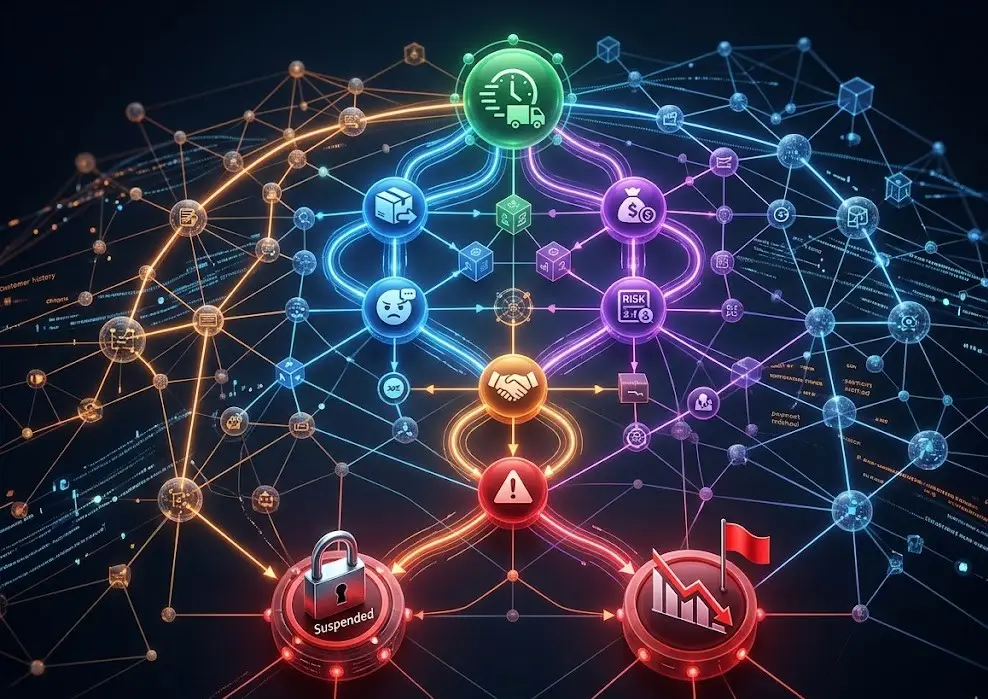
Based on the strict official Acceptable Use Policies of massive processors like Stripe, Shopify Payments, and PayPal, your merchant account health is tied directly to a metric known as the “Dispute Rate” or chargeback ratio. Stripe Radar (their machine-learning fraud system) officially flags accounts for manual review when this dispute rate exceeds 0.75%. The cascade of failure that destroys businesses usually happens in a highly predictable, specific sequence:
Prolonged Handling Times + API Latency ➔ Delayed Tracking ➔ Customer Anxiety ➔ Complaints Surge ➔ 0.75% Red Line Triggered ➔ Account Ban.
It always begins with data failure. If your public supplier suffers from prolonged handling times, and their third-party app suffers from API latency under heavy server load, the tracking number is not synced back to your Shopify store in time. The customer checks their email, sees no update after four days, and panic sets in. Believing they have been scammed, they bypass your customer support entirely and file an “Item Not Received” complaint directly with PayPal. Once these complaints surge past the 0.75% threshold, the algorithm strikes autonomously, resulting in a devastating 180-day freeze on your funds. This freezes your ability to pay for ads, pay suppliers, and effectively bankrupts the operation within weeks.
Professional Guarantees: Implementing the Black Gold Standard
When a customer receives a defective or damaged item from a massive public directory, the supplier often deploys a strategy of attrition. They will demand a certified damage report stamped by the local postal service—an absurd, impossible request that infuriates the buyer and forces them straight to their credit card company to initiate a chargeback.
To counteract this systemic industry failure, the SpeedBee architecture deploys what is internally known as the “Black Gold Guarantees.” It operates on a strict principle of Zero-Friction Replacements: if an item is lost in transit by the carrier or damaged upon arrival, the merchant simply provides a photo from the customer. A free reshipment is processed instantly, without weeks of haggling or bureaucratic friction.
Furthermore, to ensure absolute operational alignment and accountability, clients are granted direct communication access to the executive team. If the agreed-upon Service Level Agreement (SLA)—such as the 48-hour processing window or the 7-10 day stable fulfillment metric—is breached, clients can escalate the issue directly to CEO Lin Fangjun. In these instances, the merchant is entitled to a $50 account credit penalty compensation per verified infraction. This level of institutional accountability and “reverse-fining” is virtually non-existent in massive, faceless public SaaS directories, and it serves as the ultimate proof of operational confidence.
Proven Tech Stack Combinations for 2026 E-Commerce
To eliminate the guesswork and technical debt, we have audited and formulated the two most resilient e-commerce tech stack architectures for the current global landscape. These combinations align the right software with the right supply chain stage.
The Zero-to-One Bootstrapper Stack
This architecture is designed strictly for the testing phase, optimizing for minimal upfront capital expenditure while validating market demand.
- Front-End Interface: Shopify Basic ($39/mo) – Provides rapid deployment and reliable checkout compliance.
- Back-End Integration: DSers + AliExpress – This is ideal for rapidly testing 1-3 highly targeted SKUs to validate product-market fit without any upfront inventory commitment. It is crucial, however, not to scale volume on this stack due to the shipping volatility previously discussed.
- Support Layer: Loox (for importing basic visual reviews) coupled with standard email ticketing software.
The High-LTV Brand Builder Stack
Designed for merchants who have successfully validated a winning product, possess consistent daily order volume, and need to transition into a scalable enterprise focused on high Customer Lifetime Value (LTV) and repurchase rates.
- Front-End Interface: Shopify Advanced – Utilizing custom reporting structures to meticulously track cohort analysis, LTV, and blended Customer Acquisition Costs.
- Back-End Integration: SpeedBee Private Supplier – Leveraging direct factory sourcing, exclusive dedicated inventory allocation, customized unboxing experiences, and automated tracking syncing to secure payment gateways.
- Support Layer: Zendesk (for omnichannel professional customer service) integrated deeply with Klaviyo (for advanced post-purchase email flows and automated upselling).
Automated Order Fulfillment: Scaling Beyond the Basics
As you look toward the future of your enterprise, you must internalize a fundamental truth: your true competitive advantage is your ability to acquire human attention through creative marketing and media buying, not your ability to manually argue with unpredictable overseas suppliers over delayed tracking links.
By selecting a supply chain partner that operates invisibly, flawlessly, and accountably in the background, you liberate your most valuable commercial asset—your time. True business scaling happens when you transition from acting as a glorified customer service representative managing logistical failures to acting as an executive orchestrating global commerce. Choose your foundational infrastructure wisely, secure your backend data flows against algorithmic audits, and permanently take back control of your e-commerce destiny.
Ready to Take Back Control of Your Supply Chain?
Stop risking your payment gateways with shared inventory networks. Upgrade to enterprise-grade logistics designed for serious merchants.
- ✓ Seamless Integration: 1-click Shopify connection via a dedicated, secure Private App/API without technical friction.
- ✓ Zero Friction Testing: No initial Minimum Order Quantity (MOQ) required to initiate operations.
- ✓ Transparent Economics: Pure product and shipping costs with zero hidden monthly SaaS subscriptions or forced tier upgrades.




 English
  Spanish
  French
  German