
Dropshipping Suppliers Decoded: Platform, Directory, or Private Agent — Which Model Fits Your Stage?
Scaling your Shopify store only to face silent suppliers, delayed shipments, and angry customers? That frustration points to a deeper issue: you might be using the wrong type of dropshipping supplier. This guide decodes the three core supplier models so you can match the right partner to your business stage.
The Hidden Costs of Working with the Wrong Dropshipping Supplier
Most dropshippers think the cost of a bad supplier is “shipping takes a few extra days.” The real number is a lot bigger. Parcel Perform, analyzing billions of tracked shipments, found that fragmented supplier logistics costs $42 per order. That breaks down to $7 in wasted labor from juggling multiple supplier portals, $8 in WISMO (“Where Is My Order?”) support tickets, $5 in manual order-shipment reconciliation errors, $6 in reactive service recovery discounts, $4 in fragmented tech-stack overhead, and $12 in lost sales from vague delivery date promises at checkout (Parcel Perform, 2025).
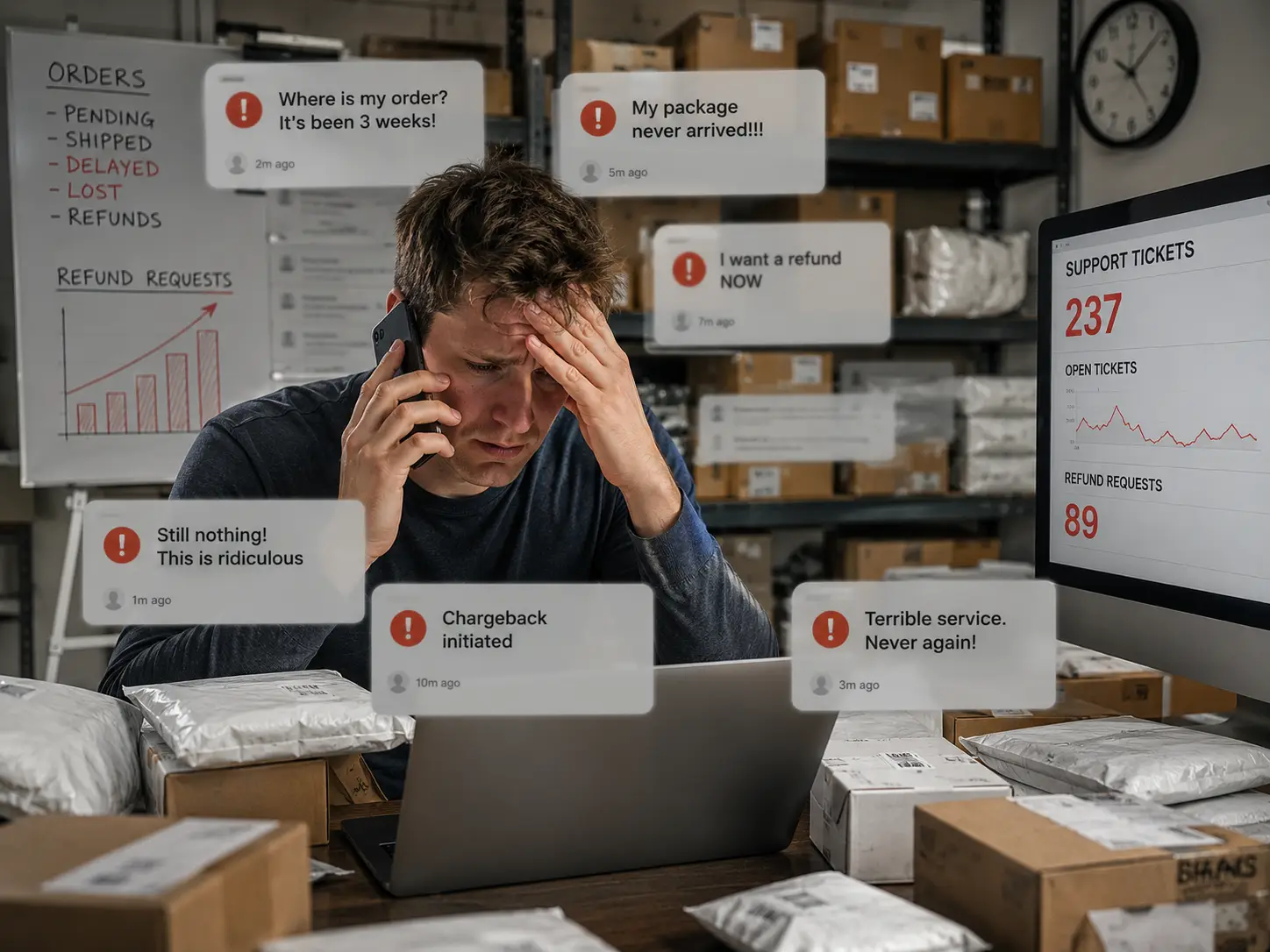
That $42 leakage per order, multiplied across hundreds of monthly orders, turns what looked like a profitable store into a break-even operation. It helps explain a brutal industry statistic: 80% of dropshippers quit within the first year, and unreliable suppliers contribute to 50% of those failures (FreightAmigo, 2025).
The deeper problem isn’t that suppliers are inherently unreliable — it’s that most dropshippers never realize they’re comparing different species of supplier as if they were the same animal. A platform marketplace, a supplier directory, and a private dropshipping agent operate on fundamentally different incentive structures. Once you understand those structures, the question shifts from “which supplier is best?” to “which supplier model is right for my current stage?”
The Three Types of Dropshipping Suppliers — And Why the Difference Matters
Before you compare supplier names, compare supplier models. The dropshipping world sorts into three architectures, and the difference between them isn’t about who has the most products — it’s about who has the most skin in your game.
| Dimension | Platform Marketplace | Supplier Directory | Private Agent |
|---|---|---|---|
| Core Model | Matchmaking — you vs. multiple independent suppliers on one interface | Information — a verified database; you do your own outreach | Dedicated service — one team handles sourcing through delivery |
| Inventory Ownership | Suppliers hold their own stock | No inventory held | Agent can hold stock for you (own warehouse) |
| Quality Control | Supplier self-reports; no unified standard | Zero QC | Per-unit inspection with photo/video proof before shipping |
| Branding Capability | Limited or none | None | Custom packaging, inserts, labels — often with no minimum order |
| Response Time | 12–24 hours via shared ticket queue | Not applicable | Dedicated account manager, typically under 20 minutes |
| Best For (Stage) | Testing — under 20 orders/day | Early research — finding suppliers to contact | Scaling — 50+ orders/day, validated winning products |
| Example Players | Spocket, Syncee, Zendrop | Worldwide Brands, SaleHoo | SpeedBee, ASG, Dropship Agent |
Platform Marketplaces — The “App Store” of Dropshipping
Think of a platform marketplace as the App Store for products: multiple suppliers list their inventory on one interface, you browse and select what to sell, and the platform handles the technical connection between your store and their fulfillment. When you’re testing products and doing under 20 orders a day, this model works nearly perfectly — zero upfront commitment, instant catalog access, and the ability to test 10 products across 5 suppliers without a single phone call.
Three platforms dominate this space. Spocket — curated US and European suppliers, 2–5 day shipping to those markets, branded invoicing, $39.99/month starting tier, integrates with Shopify, WooCommerce, Wix, and BigCommerce. Best for stores where delivery speed to US/EU customers is the primary concern. Syncee — a global network of 12,000+ brands and 8 million products, free plan for up to 25 products, 24/7 support, headquartered in Hungary. Best for multi-niche stores that need to cast a wide net. Zendrop — 1 million+ products with US warehouse options delivering in under 5 days, free plan available, custom branding and subscription box features on higher tiers. Best for Shopify-first sellers who want US-based fulfillment speed with room to grow into branding (Syncee, 2026; Zendrop, 2026; Spocket, 2026).
But here’s the structural limitation every platform shares: the suppliers on these platforms serve hundreds of stores simultaneously. Your order is one ticket in a shared queue. When volumes are low, that queue moves fast. When it grows, you have no leverage — the platform supplier’s business doesn’t meaningfully depend on your account. This is the invisible ceiling. It’s not about platform quality; it’s about incentive architecture.
Supplier Directories — The Research Phase Tool
A supplier directory is a phone book, not a fulfillment partner. You pay for access to a verified database of supplier contacts, then you do the outreach, negotiation, and relationship management yourself.
Worldwide Brands, operating since 1999, offers 16 million products from over 8,000 certified suppliers for a one-time $299 lifetime access fee — but does not integrate with any e-commerce platform for automated fulfillment. SaleHoo, based in New Zealand, provides 8,000+ pre-vetted suppliers and 2.5 million products at $27/month, with a particularly strong network for Australian and New Zealand markets (Worldwide Brands, 2026; SaleHoo, 2026).
Directories serve one narrow use case well: the research phase, when you’re still identifying who exists in your niche. They are not an operating system for your business. If what you need is “someone to fulfill orders while I sleep,” a directory is the wrong tool. If what you need is “I want to verify these five factories exist before I fly to China,” a directory is exactly right.
Private Agents — The “One Team, Your Brand” Model
A private dropshipping agent is a dedicated team — typically operating out of a manufacturing cluster like China’s Pearl River Delta — that handles the full chain: factory sourcing, per-unit quality inspection, warehousing, custom branding and packaging, international shipping, and after-sales support. Unlike a platform where you’re one of thousands of accounts, a private agent works exclusively for a capped number of clients, typically 20–50 stores.
The operational differences are quantitative, not just qualitative. Platform suppliers typically show defect rates around 8%. Quality checks, if they happen at all, are spot-sampling rather than per-unit. Private agents who photograph every batch before shipping report defect rates closer to 0.3%, a 26x improvement (ASG Dropshipping, 2026; Shopify Community, 2025). Shipping through dedicated freight lines like YunExpress, CNE, and 4PX hits 4–8 days to the US and Europe. Standard platform postal channels take 15–20 days. Cost of goods drops by 15–30% because agents source direct from factories on 1688.com and through supplier relationships inside industrial clusters. Platform catalogs, by contrast, layer on 20–40% marketplace markups.
This model isn’t for everyone. Below roughly 20 orders per day per SKU, the agent’s service fees outweigh the savings they generate. The economic crossover happens around 50 daily orders — before that point, a platform’s zero-commitment flexibility is the mathematically correct choice. After it, staying on a platform means leaving 15–30% of your per-unit margin on the table, accepting an 8% defect rate that generates customer service costs, and competing without branded packaging that builds repeat purchase behavior.
To understand the agent landscape globally: Dropship Agent, a US-based operation rated 4.6/5 on Trustpilot, offers Slack-based real-time communication and personalized fulfillment management — strong on responsiveness, limited in scale. ASG, with global 3PL partnerships, adds compliance documentation support (CE, RoHS, FDA) and Amazon FBA prep services — strong on compliance breadth, requires meaningful volume to justify costs. ShipBob, with 30+ fulfillment centers across the US, Canada, UK, EU, and Australia, delivers 2-day shipping to 100% of the continental US — the fastest pure fulfillment option, but important to note: ShipBob is a 3PL that stores and ships inventory you’ve already sourced; it does not do factory sourcing or quality inspection (Dropship Agent, 2026; ASG Dropshipping, 2026; ShipBob, 2026).
A China-based private agent like SpeedBee, operating direct from Guangzhou’s Pearl River Delta supplier cluster since 1988, represents a distinct geographic value proposition within this landscape. When an agent’s team works within driving distance of the factories they source from, they can visit production lines, inspect materials in person, and negotiate factory-gate pricing that a remote coordinator — however responsive — typically cannot match. SpeedBee’s 10,000-square-meter warehouse, 6-month free storage policy, and per-unit QC process with photographic confirmation add concrete operational capabilities that address the exact pain points identified earlier: defect rates, shipping delays, and fragmented supplier management. This does not make SpeedBee “the best” agent — it makes them one configuration of the agent model worth evaluating alongside US-based alternatives, depending on whether your priority is cost structure (favoring factory-proximate agents) or proximity to your end customer (favoring US-based agents with domestic 3PL partnerships).
Platform Marketplaces in Depth — When They’re the Right Call
If your store is doing under 20 orders a day, a platform marketplace is almost certainly where you should be. The zero-commitment model, instant catalog access, and automated Shopify/WooCommerce integration are purpose-built for the testing phase. The question isn’t whether to use a platform — it’s which one, and when to recognize you’re outgrowing it.
Before comparing specific platforms, anchor your evaluation on three dimensions: shipping speed to your target market (the single biggest driver of customer satisfaction and repeat purchase), integration depth with your e-commerce platform (every manual step between order and fulfillment is a failure point), and the platform’s ceiling — at what daily order volume does the platform model itself become the bottleneck?
Spocket — Fast US/EU Shipping with Vetted Suppliers
Spocket’s core proposition is supplier curation for Western markets: roughly 80% of its suppliers are based in the US or Europe, translating to 2–5 day domestic shipping for those regions. Branded invoicing — where the packing slip carries your store’s name rather than the supplier’s — is built into the platform, not an add-on. Sample ordering lets you test physical product quality before listing.
Best for stores whose customers are primarily in the US, Canada, UK, or EU and who compete on delivery experience rather than absolute lowest price. The ceiling: Spocket is a pure marketplace — it connects you to suppliers but owns no warehouse, runs no quality control of its own, and cannot source products outside its existing supplier network. At $39.99/month for the starter plan, it’s accessible but not free (Spocket, 2026).
Syncee — The Global Network for Multi-Niche Testing
Syncee’s differentiator is breadth: 12,000+ brands across virtually every consumer category, with a free plan that lets you import 25 products — useful if you’re testing across multiple niches simultaneously. The platform is headquartered in Hungary and built for global coverage rather than any one regional market.
Best for stores that need to test products across different categories — apparel, home goods, electronics — without committing to separate supplier relationships for each. The trade-off: supplier quality varies significantly because Syncee’s vetting is lighter than a curated platform, and there is no unified quality control standard across its network (Syncee, 2026).
Zendrop — US Warehousing for the Shopify-First Seller
Zendrop occupies an interesting middle ground: it’s a platform marketplace with a free tier, but its paid plans ($49/month Pro, $79/month Plus) layer on capabilities that start to resemble an agent — US-based warehousing with sub-5-day delivery, custom branding and packaging, and subscription box functionality. It also offers a separate Private Agent program for higher-volume sellers, making it one of the few platforms with a built-in upgrade path.
Best for Shopify store owners who want to start on a free platform but anticipate growing into branded fulfillment — Zendrop lets you test products at zero cost and transition winning SKUs to its warehousing and branding services without switching providers entirely. The ceiling: branding and warehousing require paid plans; the product catalog, while large (1 million+ SKUs), is still a shared catalog visible to competitors (Zendrop, 2026).
The Private Agent Model — What Changes When You Move Beyond the Marketplace
The existence of the private agent model is itself a market response to platform limitations. Platforms solve the discovery problem brilliantly — finding products, connecting to stores, automating the technical layer. But they were never designed to solve the accountability problem: who inspects every unit? Who owns the customer experience when something goes wrong? Who invests in your brand rather than their platform?
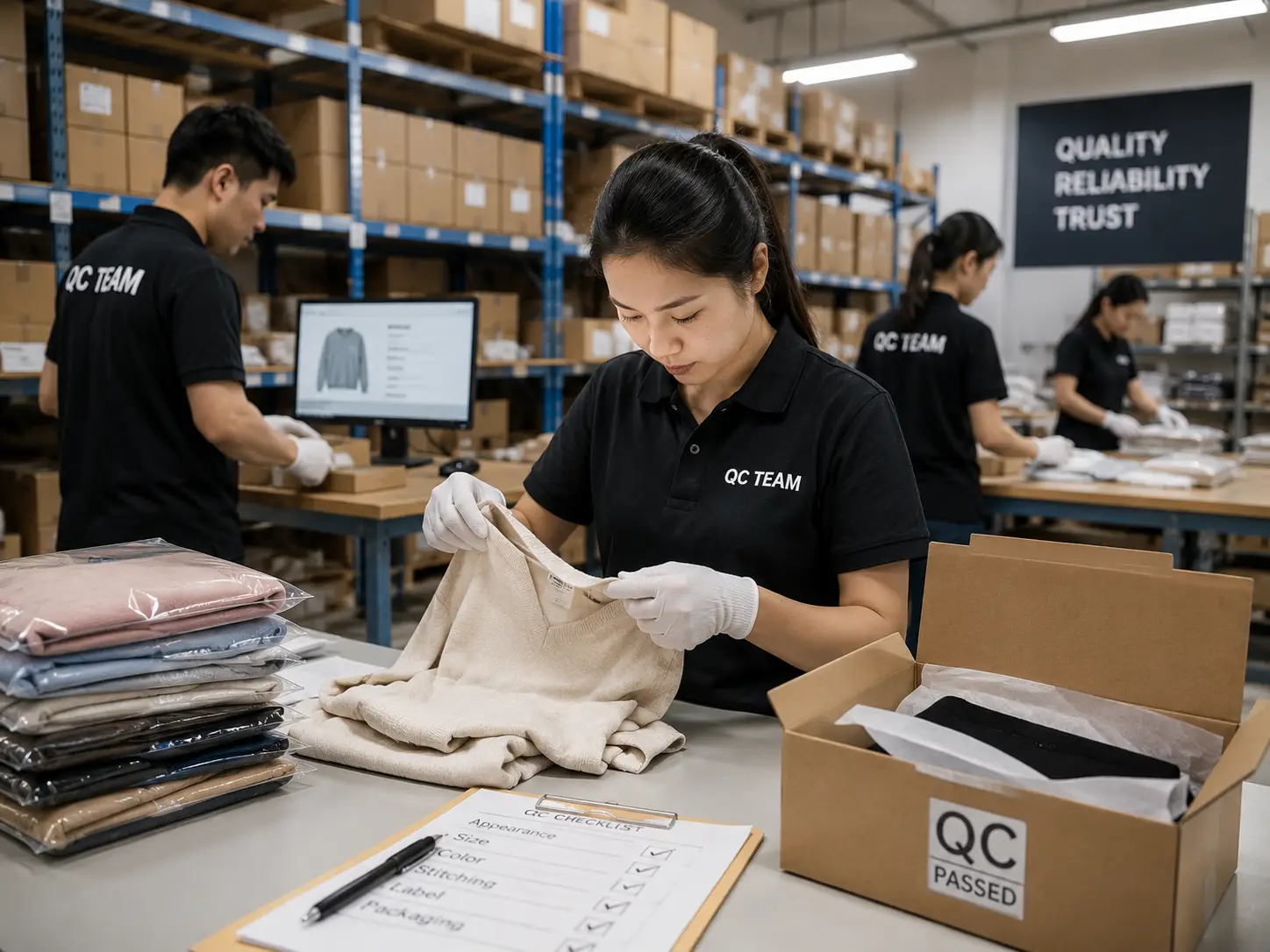
A private agent’s operational chain runs like this. Factory sourcing happens on China’s 1688.com (3 million+ factories) or through on-the-ground visits to industrial clusters — not from a shared online catalog. Incoming inventory goes through per-unit quality inspection with photographs sent to you for approval before shipping, never spot-check sampling. Branded packaging, custom inserts, thank-you cards, and labels get applied at the agent’s warehouse with no minimum order quantity. Factories typically demand 500-unit MOQs for the same work. Shipping uses multiple dedicated freight lines (YunExpress, CNE, 4PX, and others) that the agent switches between based on season, destination, and cost, rather than a single standard postal channel.
The numbers that matter: cost of goods sold drops 15–30% because you’re paying factory-gate prices plus a transparent service fee (typically $2–5 per order covering QC, packaging, and handling), rather than a platform-catalog price that embeds a 20–40% supplier margin. Defect rates fall from an industry average around 8% to approximately 0.3% when per-unit QC with photographic confirmation is standard operating procedure. Response time shifts from a 12–24-hour shared ticket queue to a dedicated account manager reachable in under 20 minutes on WhatsApp or WeChat. And critically, when a winning product starts moving 50+ units a day, the agent can pre-stock inventory in their warehouse to absorb demand spikes — something no platform model offers.
The honest caveat: this model requires volume to make economic sense. Below roughly 20 orders per day, agent service fees eat the margin savings. The crossover happens around 50 daily orders, where the combination of lower COGS, lower defect-induced customer service costs, and higher repeat purchase rates from branded packaging makes the math unambiguously favorable. This isn’t a criticism of the agent model — it’s a feature. Agents are scaling infrastructure, not starter kits.
Beyond Shipping — What a Full-Service Dropshipping Supplier Actually Delivers
Most “best dropshipping suppliers” articles define a supplier by two dimensions: product catalog size and shipping speed. A full-service supplier operates across five dimensions, and each one directly impacts your unit economics.
Sourcing Depth. A platform gives you a catalog. An agent gives you a sourcing team. The difference matters when your winning product’s factory raises prices, discontinues a variant, or drops in quality — an agent with relationships across the Pearl River Delta’s 3 million-plus factories on 1688.com can find an alternative production line within days. A platform shows you whatever its existing suppliers choose to list. When 50% of dropshipping failures trace back to supplier issues (FreightAmigo, 2025), sourcing redundancy isn’t a luxury — it’s survival infrastructure.
Quality Control That Produces Evidence. “Our suppliers check quality” is not QC. QC means every unit is inspected against a defined checklist, photographed, and the photos are sent to you before the batch ships. The output gap: platform-average defect rates around 8% versus agent-level rates of roughly 0.3% with per-unit verification — a difference that, at 100 orders a day with a $30 average order value and a 15% return-processing cost, translates to roughly $360/month in avoidable return costs alone.
Branding Without Minimums. The single most underrated growth lever in dropshipping is the unboxing experience. When a customer receives a branded package with a custom insert and thank-you card, they remember your store — not the supplier’s brown box. Platform suppliers typically require 100–500 unit minimums for custom packaging. Private agents, because they handle packaging in their own warehouse rather than at the factory, can apply custom branding at the individual order level — no MOQ. This is how you build a brand on a dropshipping supply chain: not by manufacturing your own products, but by controlling the layer the customer actually sees.
Strategic Warehousing. A supplier having “a warehouse” is not the same as the supplier holding your inventory. Platform suppliers hold their own stock and ship on demand — when that stock runs out during Q4, your orders wait. A private agent with dedicated warehouse space can pre-stock your validated winning products, absorbing the Q4 demand spike that breaks platform-dependent stores. Some agents, like SpeedBee with its 10,000-square-meter Guangzhou facility, offer several months of free storage — transforming warehousing from a cost center into a seasonal buffer.
After-Sales Accountability. When a platform order arrives damaged, you file a dispute with a supplier who serves 200 other stores and has limited incentive to prioritize your $30 claim. When an agent-handled order has an issue, the agent absorbs the cost — free replacement or refund, because their business model depends on your long-term satisfaction, not your one-time order. The structural difference in incentive alignment determines whether “after-sales support” is a real capability or a line on a sales page.
Matching Your Business Stage to the Right Supplier Model
Everything in this article converges on one framework. Use it to diagnose where you are and what should change.
| Your Stage | Daily Orders | Recommended Model | What to Do | When to Upgrade |
|---|---|---|---|---|
| Testing | Under 20 | Platform Marketplace | Use Spocket, Syncee, or Zendrop free plans to test 5–10 products across categories. Measure: shipping speed to your target market, customer feedback on product quality, per-unit margin after all fees. | When you’re manually managing 3+ supplier relationships, or over 10% of customer complaints are logistics-related |
| Growing | 20–50 | Hybrid (Platform + Agent) | Migrate 2–3 validated winning products to a private agent for better margins and QC. Continue using platforms to test new products. Measure: whether per-unit QC reduces your return rate, whether factory-direct pricing improves per-unit margin by at least 15%. | When winning products contribute 70%+ of revenue and platform-tested new products show diminishing ROI |
| Scaling | 50+ | Private Agent | Move primary product lines to a dedicated agent. Pre-stock inventory before Q4 (deadline: mid-September). Measure: branded packaging impact on repeat purchase rate, agent response time during peak periods, defect-rate trend over 3 months. | — |
The testing stage is where most dropshippers should stay longer than they think. The zero-commitment flexibility of platforms is the correct tool for finding product-market fit. The growing stage is where most dropshippers get stuck — they sense platforms are limiting them but aren’t sure the agent model is worth the commitment. The litmus test: if your monthly profit from winning products exceeds three times an agent’s estimated monthly service fees, the migration is net-positive from month one.
China-based agent (like SpeedBee in Guangzhou’s Pearl River Delta): factory-gate pricing, on-the-ground QC, deeper supply chain control.
US-based agent: domestic shipping speed, customer proximity, simpler communication time zones.
For stores in the scaling stage, the decision between a China-based agent and a US-based agent reduces to a geographic trade-off. A China-based agent operating within the Pearl River Delta industrial cluster — like SpeedBee, with its Guangzhou warehouse and factory-direct sourcing network — offers a structural cost advantage because it eliminates the intermediary layers between factory and fulfillment. A US-based agent offers proximity to end customers and domestic shipping speed. The right choice depends on whether your margin structure or your delivery speed is the binding constraint on growth.
Your Dropshipping Supplier Vetting Checklist
Before you contact any supplier — platform, directory, or agent — lock in three answers:
- Your target market countries. US? UK? EU? Australia? This determines the shipping speed you need.
- Your current or projected daily order volume. This determines which supplier model is economically viable for you.
- Your non-negotiables. Branded packaging? Per-unit QC with photo proof? After-sales accountability? Free returns for defects? Clarify these before conversations begin — they’ll eliminate 80% of options immediately.
Once you’re evaluating specific suppliers, run these ten checks:
- Ask for three verifiable client references — not curated testimonials, but store owners you can contact.
- Place a 50-unit test order across 3–5 different SKUs. One unit can’t test consistency; 50 can.
- Require per-unit QC photos in your inbox within 72 hours. Delay beyond that means the supplier is likely sourcing on-demand rather than holding inventory.
- Test response speed: send three messages at different times across 48 hours (your business hours, their business hours, and a weekend). A serious supplier replies within 12 hours across all three.
- Verify that tracking numbers show carrier scans, not just label creation. A tracking number that sits at “label created” for four days is not a shipment — it’s a promise.
- Confirm the after-sales policy in writing: who pays for damage, loss, and quality defects? What’s the resolution timeline? If the answer is vague, walk away.
- Demand a transparent pricing grid — product cost, service fee, shipping fee, and customization fee as separate line items. “All-inclusive pricing” is a red flag for hidden margins.
- Verify warehouse claims: if the supplier says they have “US/EU warehouses,” ask for a real-time inventory screenshot of a specific SKU in that warehouse. Claims without verification are marketing.
- Get the communication channel: dedicated WhatsApp/WeChat/Slack with a named account manager beats a shared support email by roughly the difference between a text to a friend and a letter to a government agency.
Looking for UK-specific options? Our guide to the best dropshipping suppliers UK covers vetted partners with local warehouses and fast domestic delivery. For a focused look at a specific market, our dropshipping suppliers Australia guide breaks down verified local and international suppliers for Aussie merchants.
References
- Parcel Perform. “The Dropshipper’s $42 Crisis: Fixing Logistics for AI Commerce.” 2025. https://www.parcelperform.com/insights/fixing-dropshipping-logistics-crisis
- FreightAmigo. “Navigating the Challenges of Dropshipping: Success Rates and Best Practices.” 2025. https://www.freightamigo.com/en/blog/logistics/navigating-the-challenges-of-dropshipping-success-rates-and-best-practices/
- ASG Dropshipping. “What Does a Dropshipping Agent Do? (The Honest Answer).” 2026. https://asgdropshipping.com/what-does-a-dropshipping-agent-do-the-honest-answer/
- ASG Dropshipping. “CJ Dropshipping vs Private Agent: Which One Is Right for Your Stage?” 2026. https://asgdropshipping.com/cj-dropshipping-vs-private-agent-which-one-is-right-for-your-stage/
- Spocket. “Best Dropshipping Platforms Compared.” 2026. https://www.spocket.co
- Syncee. “Global Dropshipping Marketplace.” 2026. https://syncee.com
- Zendrop. “Private Agent for Dropshippers and Brands.” 2026. https://www.zendrop.com
- Dropship Agent. Trustpilot Reviews. 2026. https://dropshipagent.com
- ShipBob. “Global 3PL Fulfillment Services.” 2026. https://www.shipbob.com
- Worldwide Brands. “Certified Wholesale Supplier Directory.” 2026. https://www.worldwidebrands.com
- SaleHoo. “Wholesale Supplier Directory & Market Research Tools.” 2026. https://www.salehoo.com
- Shopify Community. “Dropshippers Using AliExpress — What’s Your Real Experience?” 2025. https://community.shopify.com/t/dropshippers-using-aliexpress-what-s-your-real-experience/586600/2
- Shopify Community. “Struggling With Slow Suppliers? How Are You Handling Fulfillment Delays in 2025?” 2025. https://community.shopify.com/t/struggling-with-slow-suppliers-how-are-you-handling-fulfillment-delays-in-2025/575884


 English
  Spanish
  French
  German
  Italian
  Polish