
If you sell furniture through your Shopify store, you already know the fear. A customer messages you about a scratched bedside table. You check your supplier’s returns policy — three lines on a PDF. The supplier offers to replace the product but won’t cover the £35 return shipping. You’re now legally responsible to your customer under UK consumer law, but your supplier controls the product, the packaging, and the courier. The gap between your legal liability and your supplier’s accountability is where furniture dropshipping gets expensive.
This guide maps the UK furniture dropshipping supplier landscape: who the players are, what they actually deliver, and the questions to ask before connecting your store to any of them. We’ll also examine a supply chain model that most UK-centric lists ignore: China-based fulfillment partners that combine Pearl River Delta sourcing depth with UK-competitive delivery speeds. Whether you’re launching your first furniture line or scaling past 200 orders a month, your supplier choice shapes both your margins and your customer reviews.
What Makes Furniture Dropshipping Different from General Dropshipping
Dropshipping phone cases and dropshipping furniture share a business model in name only. The operational reality — and the suppliers you need — are different.
Returns and damage cost real money. In general dropshipping, a damaged product might cost you £5 to replace. In furniture, a single damaged sofa can wipe out weeks of profit. Furniture return rates typically run 3–8%, compared to 1–3% for smaller goods. Each return involves bulky freight charges that eat into margins faster than the product cost itself. Take a £300 bedside table that arrives with a scratch. The £80 wholesale cost is only part of the story. Add £25 in outbound dimensional-weight shipping and £30 for the return leg, and a single defective unit costs you £135 — before you’ve dealt with the customer service fallout.
Shipping isn’t predictable — it’s dimensional. Furniture freight is priced by volumetric weight: (length × width × height) ÷ 5,000 for air freight. A lightweight rattan chair can cost more to ship than a heavy but compact electronics package. UK-based suppliers shield you from some of this complexity. Source from overseas, and dimensional-weight surprises become one of the most common reasons dropshippers watch their margins evaporate between the product page and the delivery confirmation.
You’re legally responsible — but your supplier holds the cards. Under the UK Consumer Rights Act 2015, your customer can reject faulty goods within 30 days and receive a full refund. That obligation lands on you, the retailer. But your supplier controls product quality, packaging standards, and carrier selection — the three variables that determine whether a product arrives intact. This split between your legal liability and your supplier’s operational control is the core structural risk in furniture dropshipping. It’s why supplier vetting matters more in this category than in any other.
Understanding these three realities — damage economics, dimensional shipping, and legal liability — changes how you evaluate suppliers. The question isn’t “who sells furniture?” It’s “who has built their operations around the specific risks of furniture fulfillment?”
UK-Based Furniture Dropshipping Suppliers at a Glance
UK furniture dropshipping suppliers fall into three categories: specialist furniture wholesalers who added dropshipping to their trade business, multi-category dropshipping platforms where furniture is one category among many, and international platforms that serve the UK market from EU warehouses. Each type suits a different stage of your business — and each carries different risks.
Specialist Furniture Wholesalers — The Quality-First Route
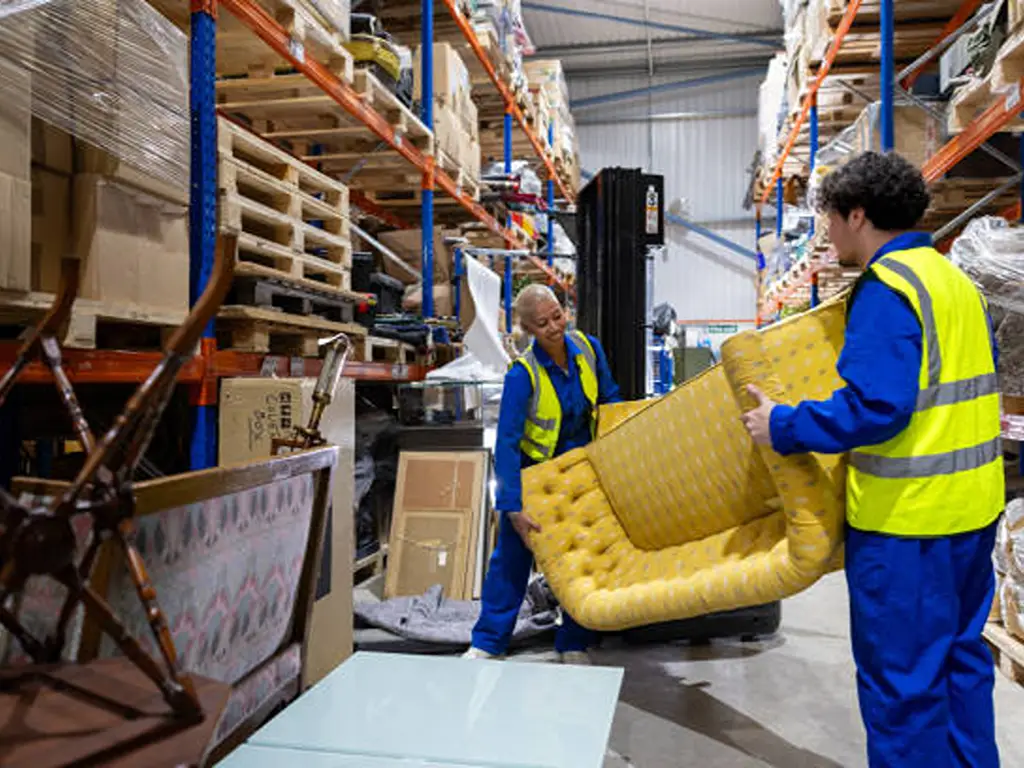
If your store competes on product quality rather than lowest price, specialist UK furniture wholesalers are the natural starting point. These companies built their businesses on B2B wholesale, then layered dropshipping on top — which means their logistics are furniture-native, but their dropshipping programs vary widely in sophistication.
Artisan Furniture operates the most mature dropship program in this category. Based in London with a UK distribution centre in Ipswich and their own factory in Jaipur, India, they offer over 1,000 SKUs of solid wood, upholstered, and hand-painted furniture with no minimum order on their dropship tier. Delivery is free to UK mainland addresses in approximately three working days via DHL, with white-label shipping — your customer never sees an Artisan packaging reference. Their Shopify, WooCommerce, eBay, Amazon, and Etsy integrations make them the most platform-ready option for multi-channel sellers. Trade buyers spending over £2,500 per order unlock 25% discounts, and full container wholesale brings pricing down to 50% off dropship rates. Reviews on Houzz and TheWholesaler are broadly positive — “impeccable customer service” and fast dispatch are recurring themes — though several reviewers note a strict returns policy, and occasional quality variance is acknowledged as inherent to handmade imports.
Amos Mann Furniture, operating out of Leicester since 2013, is a trade-only wholesaler with a comprehensive dropship service. Their strength is range breadth: they carry bedroom, office, dining, and lounge furniture across ten-plus branded ranges including Anzo, Ivana, Kano, and Lucerne — all held in their UK warehouse. This is a traditional wholesaler model: UK stock, trade pricing behind a login, and prompt dispatch. If your customers are in the UK and you want furniture already on British soil, Amos Mann eliminates the lead-time uncertainty of imports.
Birlea Furniture focuses on beds, mattresses, sofas, and office furniture. With over 25 years in the UK market, they’re the fastest-growing furniture wholesaler in the country and hold exclusive licensed collections including Disney and SleepSoul. Their FIRA membership provides an additional layer of industry credibility for sellers whose customers research brand legitimacy.
Hill Interiors, established in 1975, is the veteran of this group. They distribute indoor and outdoor furniture, lighting, gifts, and garden accessories with low minimum orders, no minimum quantity per line, and next-day delivery. Their presence at UK trade shows like the Autumn Fair signals a business built on long-term B2B relationships rather than digital-first dropshipping — which means their online integration may be less polished than newer entrants, but their supply chain stability is backed by 50 years of wholesale distribution.
Multi-Category Dropshipping Platforms — The Breadth Play
If you’re testing multiple furniture sub-categories or just starting out with limited capital, multi-category platforms offer the lowest barrier to entry. The trade-off is straightforward: you get access to thousands of products without committing to a single wholesaler. But furniture is one of many categories — not the category these platforms are built around.
dropXL, an authorised vidaXL distributor, is the standout in this group with over 90,000 products across home, garden, furniture, and lifestyle categories. UK and EU warehouse fulfillment means competitive delivery times, and their Shopify, WooCommerce, Amazon, and eBay integrations cover the major sales channels. Their strength in outdoor and rattan furniture fills a gap that many specialist wholesalers leave open. The downside: as a general marketplace, their packaging and logistics aren’t optimised for bulky, fragile items the way a furniture-native operation would be.
Arkfw offers wholesale pricing behind a trade login — no subscription fee, fast UK shipping, and coverage spanning living room, bedroom, storage, garden furniture, and home gym equipment. They’re a practical entry point for budget-conscious beginners, particularly for flat-pack and smaller furniture items that carry lower shipping risk. Start small here — verify packaging quality with sample orders before listing £300+ pieces.
GF-Trade serves the contract and hospitality furniture niche. A family-run business with over 30 years of trading, they manufacture, import, and stock chairs, table tops, and table bases with no minimum order quantity on stock items and next-day delivery. Their white-label delivery notes and up to two-year warranty are genuine strengths. The limitation: they don’t integrate with ecommerce platforms — ordering is manual via their website or purchase order — and delivery is UK-only.
What UK Suppliers Don’t Tell You — The Hidden Gaps
List the UK suppliers, compare their catalogs and delivery times, and the picture looks complete. But three structural gaps persist across every type of UK-based furniture supplier. These gaps become more visible — and more expensive — as your business scales.
No product-level intervention. UK suppliers distribute products. They don’t visit factories to improve filling density, source anti-wrinkle fabrics, or redesign packaging to reduce transit damage. If a product in your catalog has a recurring quality issue, your UK supplier’s only lever is to replace the defective unit — not fix the root cause. For a dropshipper doing 30 orders a month, replacement works. For a dropshipper doing 200 orders a month with a 4% complaint rate, replacement without root-cause fixing drains your margins month after month.
Returns policies built for wholesale, not dropshipping. Most UK furniture wholesalers designed their returns processes for trade buyers placing bulk orders — returning a pallet of six damaged chairs is operationally straightforward. Applying the same policy to a single end-consumer return, where the return shipping costs nearly as much as the product, creates friction that lands on you. Several UK suppliers’ terms state they’ll “assess returns on a case-by-case basis” — which means you carry the risk until they decide.
Shared inventory is the default. Most UK wholesalers and platforms sell from a common stock pool. When your store and five other dropshippers all list the same bestselling oak dining table, the inventory counter doesn’t care whose customer clicks “buy” first. The sixth customer gets a backorder notification, and you get a refund request. Dedicated inventory — where your stock is physically separated and reserved for your orders alone — is rare in the UK dropshipping model but standard among China-based fulfillment partners.
This is where a different supply chain model enters the picture: China-based sourcing with UK-speed logistics and operational accountability.
What UK Dropshippers Miss — The China Fulfillment Alternative
The standard narrative is clean and simple: UK supplier equals fast and reliable, China supplier equals cheap but slow. But a class of China-based fulfillment partners has systematically dismantled that trade-off. By combining sourcing depth from the Pearl River Delta — the region that produces roughly 60% of the world’s furniture export volume — with dedicated inventory, factory-level quality intervention, and UK-competitive 3–7 day delivery, they offer a model that sits between the two extremes most dropshippers assume are the only options.
Cost Flexibility and Product Control — What China Fulfillment Actually Delivers
The cost advantage of sourcing from China isn’t just about lower unit prices. It’s about removing a layer of margin from the supply chain. A UK wholesaler buys from a manufacturer — often in China or India — marks up the product, warehouses it in the UK, and sells it to you at trade price. A China-based fulfillment partner sources directly from the same manufacturing clusters and ships to your customer without the intermediate wholesale markup. The Pearl River Delta covers furniture, electronics, and home goods; Nantong handles textiles and bedding; Yiwu specialises in home accessories.
But cost is the entry point, not the differentiator. The real difference is product control.
When a UK supplier receives a batch of bedside tables with consistently misaligned drawer slides, their options are limited: reject the batch, discount it, or sell it and absorb the returns. When a China-based fulfillment partner identifies the same issue, they can send someone to the factory floor — check the slide mechanism, verify the installation jig, fix the process at the source. This is not theoretical. One publicly documented case involved a bedding seller whose pillow complaint rate sat at 0.56% — 21 complaints on 3,750 orders in a single month. A fulfillment partner visited the Nantong factory, increased the filling density, sourced anti-wrinkle fabric, and optimised the vacuum-packaging process. The result: complaint rate dropped to 0.077% by October — roughly a 90% reduction, from 21 monthly complaints to 2, on comparable order volume (SpeedBee – Pillow Case Study, 2025).
This depth of intervention — raw material substitution, manufacturing process adjustment, packaging engineering — sits entirely outside what a distribution-only UK supplier can offer. For dropshippers scaling a product line where quality consistency directly impacts return rates and customer lifetime value, the ability to fix products at the factory level rather than just replace them at the warehouse level changes the unit economics of the entire operation.
For sellers who need more than blind fulfillment — factory-level quality upgrades, dedicated inventory, or direct access to the people making decisions about their orders — the China-based fulfillment model opens up possibilities that the UK distribution-only model can’t match. Services like SpeedBee, operating five warehouses totalling over 20,000 square metres in Guangzhou, occupy this space: China-based sourcing depth with UK-competitive delivery, combining product intervention capability with the accountability structures that traditional China sourcing lacks.
Speed and Accountability — How Modern China Fulfillment Closes the Trust Gap
The reputation of China-to-UK shipping as slow and unreliable comes from real experience: AliExpress orders that take 30-plus days, tracking numbers that go dark for two weeks, products that arrive looking nothing like the listing photos. But that experience describes a specific model — marketplace resellers drop-shipping from shared factory inventories with no quality control, using public postal routes. It does not describe what dedicated fulfillment partners have built.
Start with geography. Guangzhou sits within 200 kilometres of five international airports: Guangzhou Baiyun, Shenzhen Bao’an, Hong Kong, Zhuhai, and Macau. Hong Kong International Airport, the world’s busiest cargo airport, handles approximately 4.3 million tonnes of freight annually. For furniture dropshippers selling products with built-in batteries — LED-lit mirrors, motorised standing desks, rechargeable bedside lamps — Hong Kong isn’t just convenient. It’s essential: lithium battery regulations require these products to fly out of Hong Kong. A fulfillment centre in Guangzhou, 150 kilometres from Hong Kong airport, has a structural logistics advantage over an equivalent operation in Shanghai or Ningbo, where Hong Kong is 1,200 kilometres away and battery-product routing is far more complex.
The speed numbers are public. SpeedBee states UK express delivery “in as fast as 3 days,” with standard delivery at 4–7 days (SpeedBee – FAQs). That’s slower than a UK warehouse’s next-day delivery, but faster than most dropshippers assume is possible from China. For non-urgent furniture purchases — a dining table, a wardrobe, a bookshelf — the delivery timeline rarely triggers customer anxiety.
Speed only matters if the product arrives intact. This is where the operational design of modern fulfillment partners diverges from the marketplace model:
Video-confirmed packing. On the first order of every new SKU, the fulfillment team packs the product and films it from multiple angles — showing the item, the packaging layers, and the sealed parcel — and sends the video to the seller for sign-off before dispatch. This single step prevents the most common failure mode in dropshipping: the seller has never seen the actual product their customer is about to receive.
Dedicated inventory. Unlike shared-inventory platforms where your bestselling SKU can sell out because another seller’s customer bought the last unit, dedicated inventory means your stock is physically separated in the warehouse and allocated exclusively to your orders. Reserve 50 units, and those 50 units are yours until you sell them — with six months of free warehousing, extendable as long as you’re actively selling through.

Risk absorption. Carrier-lost parcels are reshipped free. Quality defects identified at the QC checkpoint trigger replacement before the product leaves China. Instead of you chasing a supplier for a refund while apologising to your customer, the fulfillment partner absorbs the loss and protects your customer experience.
Direct decision-maker access. The structural weakness of large dropshipping platforms is the support queue — ticket numbers, department handoffs, “we’ll escalate to the relevant team.” A smaller, operationally focused fulfillment partner puts a named person between you and a resolution. In SpeedBee’s case, the CEO sits in client business groups.
The Shopify App Store provides a useful external check: SpeedBee’s SB Fast Dropshipping Supplier app holds a 5.0-star rating as of 2026 (Shopify App Store). It’s a limited dataset — two reviews — but it’s third-party platform verification, not a self-published testimonial.
None of this suggests China-based fulfillment is right for every furniture dropshipper. If your entire catalog is flat-pack budget furniture with tight margins and you’re doing 20 orders a month, a UK platform with no subscription fee is the pragmatic starting point. The China fulfillment model becomes relevant when you hit the ceiling of what UK distribution-only suppliers can offer: when you need product quality intervention, when shared inventory starts costing you sales, when custom branding matters to your customer acquisition, or when your order volume makes the intermediate wholesale markup the single biggest line item eating your margins.
Seven Questions to Ask Before Signing Up with Any Furniture Supplier
By now you have a map of the supplier landscape: UK wholesalers, multi-category platforms, and China-based fulfillment partners. The next step isn’t picking one. It’s stress-testing your shortlist against the questions that separate suppliers who can handle furniture from those who can’t.
Matching Your Supplier Mix to Your Business Stage
You don’t need to pick one supplier. The furniture dropshippers with the healthiest margins and lowest complaint rates typically use a supplier mix that evolves with their business. The composition of that mix changes at each stage.
For dropshippers ready to move beyond blind fulfillment, services like SpeedBee combine China-based sourcing with UK-competitive 3-day delivery, dedicated inventory that won’t sell out from under you, and factory-level product upgrading — with a public track record that includes reducing a furniture seller’s complaint rate from 0.56% to 0.077%. Visit speedbeedropship.com/contact-us/ to start a conversation about whether their fulfillment model fits your product line and order volume.
References
- Shopify App Store. “SB Fast Dropshipping Supplier.” https://apps.shopify.com/sb-fast-dropshipping-supplier
- UK Legislation. “Consumer Rights Act 2015.” https://www.legislation.gov.uk/ukpga/2015/15/contents/enacted



 English
  Spanish
  French
  German
  Italian
  Polish