
A pet bed video goes viral on a Tuesday. By Friday the store that posted it is shipping forty units a day, and by the second Friday the supplier’s shared listing has gone dark. The orders are paid, the ad spend is spent, and the refund clock is running. Nothing about the product failed. The supply arrangement failed.
That sequence is the real risk in pet dropshipping, and it is also the reason the niche rewards a specific kind of seller. Americans spent $158 billion on their pets in 2025, and the American Pet Products Association projects $165 billion in 2026 (APPA, 2026). Demand is not the problem. The sellers who last are the ones who treat the supplier relationship as the core of the business, not an afterthought behind ads and product research.
This guide walks that chain in order: what the category looks like, how to pick products that survive shipping, how to vet a supplier before money moves, how to structure stock and delivery so orders survive a demand spike, and finally what the controlled version of this business is worth.

Pet Dropshipping, and Why the Niche Still Pays
The model itself is simple. You run the store, the ads, and customer service. A supplier holds inventory, packs orders, and ships them straight to your buyer under your brand. You never touch a box. What separates a hobby from a business is everything that happens inside that second sentence: whose inventory, checked by whom, shipped through which lane.
Pets make an unusually forgiving market for this model. Owners buy through emotion and habit, in every season, for animals they treat like family. Pet food, toys, and grooming are repeat purchases, so a working supplier relationship compounds instead of resetting with every sale.
The trap is that the category’s popularity hides a wide spread in difficulty. “Pet products” covers eight very different businesses, and the logistics column below is where they actually differ:
| Subcategory | Why it sells | Logistics watch-out |
|---|---|---|
| Toys & chews | Impulse-friendly, low price, giftable | Battery-powered toys route through limited air lanes |
| Grooming | Steady repeat demand | Liquids and aerosols face shipping restrictions |
| Beds & furniture | High perceived value, strong margins | Bulky: freight cost can eat the margin |
| Apparel & accessories | Photogenic, social-media friendly | Sizing variance drives returns |
| Training tools | Problem-solving purchases | Small parts; check packaging quality |
| Cleaning & hygiene | Subscription potential | Some formulas are regulated at borders |
| Feeding & bowls | Evergreen basics | Heavy relative to price; freight-sensitive |
| Smart devices (feeders, cams) | Premium price point | Batteries, plugs, and warranty expectations |
None of these are off limits. Each one just prices in a different operational risk, and the next section shows how to read that risk before you list anything.
Choosing Products That Survive the Journey
New sellers pick from trending-product videos. Sellers who last pick from the shipping table first and the trend list second. The logic is mechanical: a product’s landed cost and its review profile are decided by its physical form long before marketing enters the picture.
Three product traits do most of the damage. Bulk is the first: beds and furniture carry high perceived value, but volume-based freight pricing quietly takes the margin, which is exactly why bulky pet goods show up on “high profit” lists and disappoint in practice. Power is the second: anything with a built-in battery has fewer air lanes available, and from China that effectively means routing through Hong Kong, which affects both price and planning. Ingestibles are the third: food, chews, and supplements sit inside import and labelling rules that change by destination. Each market needs a compliance check before the listing goes live, not after the first customs hold. Fabric goods deserve a mention too. Plush beds and toys compress badly in cartons, so they travel vacuum-packed, with a dust-and-threads pass before the box seals.
Where you source from decides what promises you can even ask for. The three channels behave differently:
| Source | Typical strength | What it means for you |
|---|---|---|
| Marketplace platforms (CJ, Zendrop, AutoDS) | Fast start, huge catalogs, app integration | Inventory is usually shared; hot items can sell out from under a live ad |
| Local/US distributors (TopDawg, PetDropShipper) | Fast domestic delivery, known brands | Thin catalogs, higher unit cost, tighter margins |
| China-based sourcing agents | Full catalog range, factory prices, custom work | You inherit quality control and speed; the agent’s process decides both |
The path from zero to first stable orders is the same in every channel. Pick two or three candidate products with sane logistics profiles, shortlist two or three suppliers, run each candidate through a verification checklist before paying, place a small trial order to a friend’s address, and move whatever keeps selling onto stock you actually own. The verification step is where most stores skip, and it is where the next section lives.
How to Vet a Pet Supplier Before You Sign
Spend ten minutes in any dropshipping community and the same confession appears: the supplier looked professional, the samples were fine, and then real orders started moving (r/dropship, 2024). Sellers describe partners whose shipping times “are all over the place,” messages that go unanswered for days, and damage claims nobody wants to own (r/dropshipping, 2026). None of that shows up on a product page. All of it shows up in how the supplier answers five specific questions, so ask them before money moves, and treat vague answers as data.
Ask how the inventory is held
The question: “When I place an order, is it fulfilled from stock reserved for me, or from a shared pool other sellers can also draw from?” Shared pools are why marketplace listings vanish mid-campaign: the unit you advertised exists, but not exclusively, and whoever ships first wins. Dedicated stock, where the supplier sets inventory aside for your store, is the difference between scaling an ad and refunding an ad. An answer like “don’t worry, we always have stock” is a failing answer, because nobody always has stock; they just hope you order before it runs out.
Ask what happens before the box closes
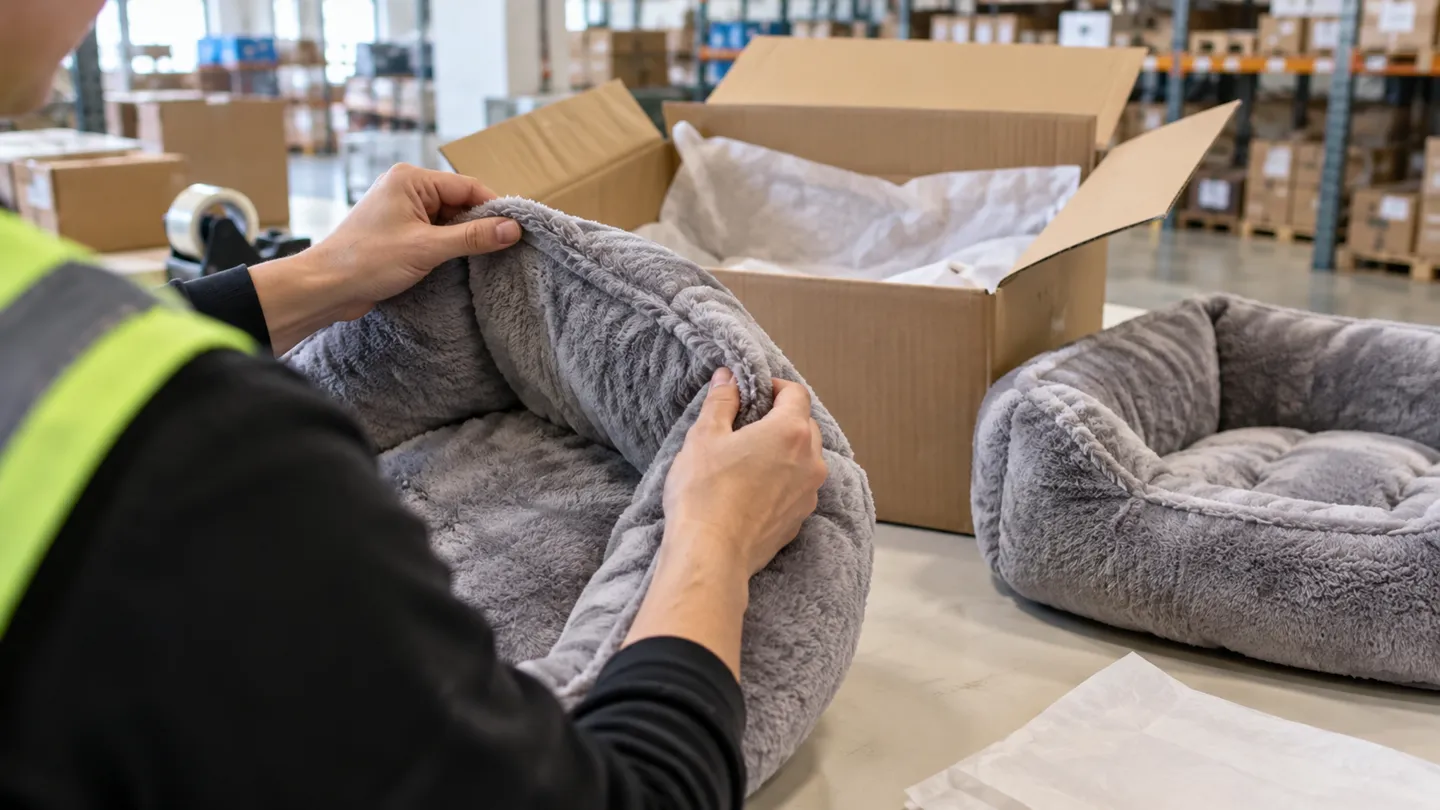
A serious fulfilment operation can describe its pre-shipment checks in concrete stages: comparing the item against your sample or photos for design and color, inspecting for stains, scratches, and cracks, powering devices on and testing battery compartments, then a final cleaning pass that removes dust and loose threads. The follow-up request costs nothing: ask for a photo of your actual packed order, or a short video of the packing method for the first shipment, so your instructions survive contact with a busy warehouse floor. “Our quality is guaranteed” is a slogan, not a process, and it is a failing answer.
Ask who pays when things break
Parcels get lost and pet products arrive damaged; the plan for that event is part of the product. The questions: for a lost parcel, is it a free reship or a refund, and how fast? For a damaged or defective unit, same question. Does the supplier ever invoice you again for a replacement on a claim that is genuinely their fault? Strong agents treat reshipping as their cost of doing business and process claims within a defined window, commonly around 48 hours from the complaint. Terms that live only in a sales rep’s messages do not exist; get them written into the quotation.
Ask who answers when it does
When a claim or a stock emergency happens, you need a person with authority, not a ticket number. Sellers who describe suppliers “ghosting” them are usually describing a structural problem: every question routed through a queue with no owner (r/dropship, 2024). Ask directly: who is my named contact, what is the response expectation in your business hours, and is there a path to a manager or founder when something is stuck? A supplier that cannot answer that before you pay will not answer it after.
Ask about the last mile
Quoted delivery times hide the part that actually fails, so ask what the quoted figure includes. Door-to-door service with customs clearance included (DDP) is the workable default for US and EU dropshipping, because it keeps tax surprises away from your customer. Then ask who physically delivers: a national post, a local courier, or the freight forwarder’s own network, and confirm you get end-to-end tracking that works in your customer’s country. As a benchmark, established China-based agents run dedicated UK lines at four to seven days door-to-door, with express services touching three days; if a quote for the same lane is materially slower, ask what leg is different before assuming the price is a bargain.
The five-question vetting checklist
Shared pool or dedicated stock?
What are your pre-shipment QC stages, and can I see my packed order?
Who pays for lost or damaged parcels, and how fast?
Who is my named contact, and who do they escalate to?
Is the quote door-to-door DDP with full tracking, and who runs the last mile?
Stock, Speed, and Who Pays When Packages Die
Vetting filters out bad suppliers. Architecture decides whether good ones can keep your orders alive when volume spikes, so this section is about the three structural choices every pet store makes: where stock sits, which speed tier it moves on, and how failure gets paid for.
Where the stock sits
Three placements dominate, and they trade speed against capital against risk in predictable ways:
| Placement | Speed | Stockout risk | Capital tied up | Fits |
|---|---|---|---|---|
| Platform shared pool | Varies widely | High: listings are shared and can vanish | None | Testing unknown products |
| Target-country warehouse | Fast domestic delivery | Medium: limited SKU range | High: goods shipped and stored in-market | Proven bestsellers in one big market |
| China warehouse, dedicated stock | 4–7 days to UK/EU/US express lanes | Low: your units are reserved and monitored | Moderate: 1–2 months of turnover stock | Stable SKUs with steady daily orders |
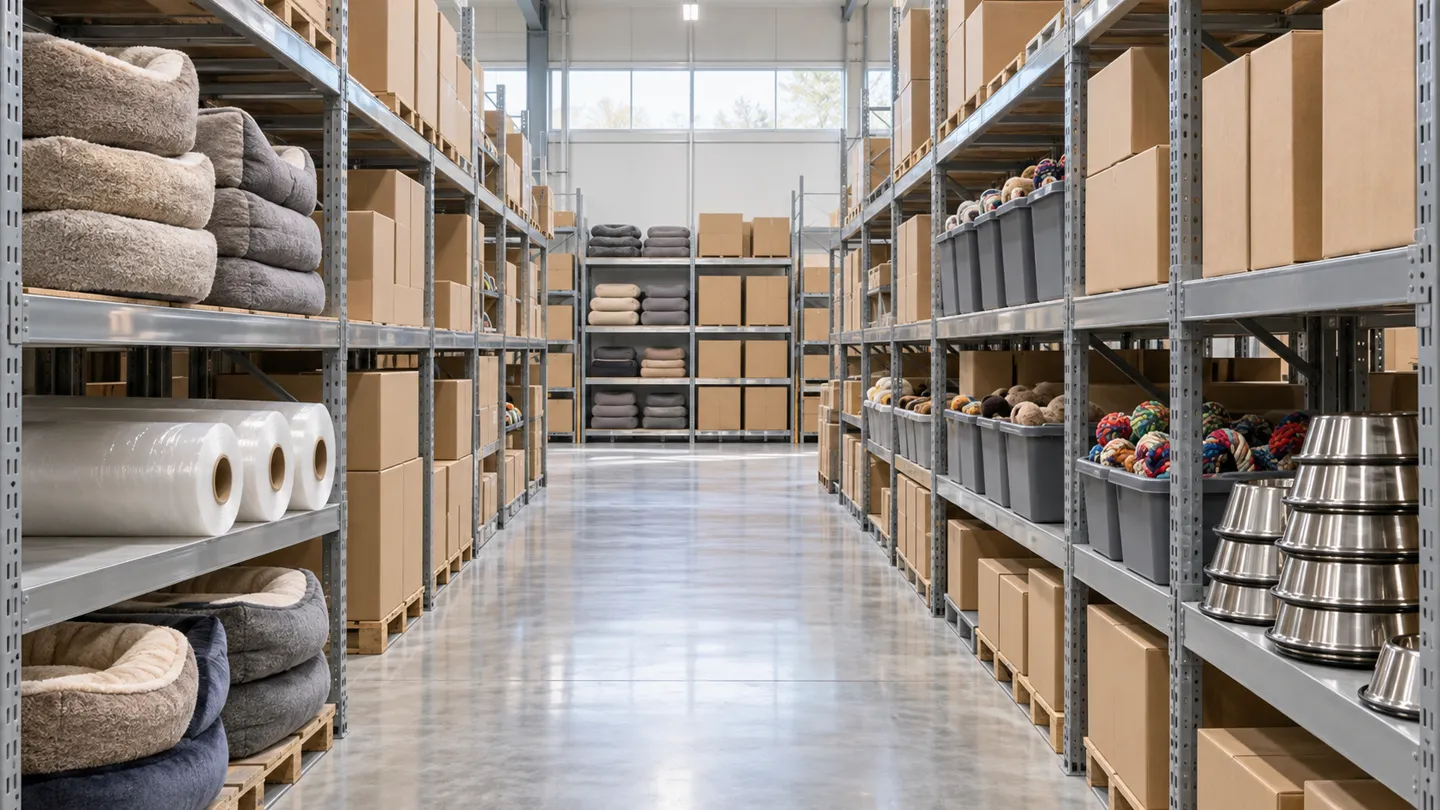
The shared pool is a testing tool, not a fulfillment strategy. The moment one SKU proves itself, the same ad that grew it will outgrow the pool, because shared inventory serves whoever orders first. Reserved stock in a China warehouse costs more attention and some working capital, and in exchange the store’s scorecard stops depending on strangers.
Speed tiers and the chain behind them
Most agent quotes offer three tiers: express, standard, and economy. The honest way to price them is by what each protects. Express protects the ad: for UK-bound parcels the express lane runs four to seven days door-to-door and can touch three, which keeps review velocity healthy during a campaign. Standard protects the margin on repeat, non-urgent items. Economy protects nothing that matters in pets, where buyers opened the parcel for a living creature waiting at home; treat it as a fallback, not an offer.
Every parcel rides the same chain: warehouse pickup, airport departure (Hong Kong for battery goods; that lane is a hard constraint, not a preference), linehaul flight, customs clearance, and last-mile delivery by the destination postal or courier network. Competent agents work this chain daily through established forwarders such as Yanwen, YunExpress, and 4PX, and can tell you which leg is slow this week. The useful question for any quote is which leg is not included, because that is where your refund requests will come from.
The damage chain: four failures and who owns them
Lost and damaged parcels sort into four cases, and the responsible party should be explicit in each: a parcel that never enters the carrier’s system is the supplier’s problem; a parcel lost in international transit is a claim the supplier runs and the customer should not see; a parcel lost in the last mile is a forwarder claim, still executed by the supplier; and a unit that arrives dirty, broken, or dead is a quality failure the supplier absorbs with a free reship or refund. The pattern to demand is simple: the buyer never pays twice, and you pay nothing on claims that are not your fault. Suppliers who process these inside a defined window (48 hours is a fair ask) and reship first, argue later, are the ones whose reviews you never have to repair.
The matrix below compresses this section into the decision it serves: match your stage to an architecture, and know the edge at which it stops working.
| Seller stage | Architecture that fits | It holds while | Move when |
|---|---|---|---|
| Testing (under ~10 orders/day, SKUs unclear) | Shared pool trial orders | You are buying data, not scale | One SKU shows steady sales: shift it out the same week |
| Scaling (one or more SKUs at steady daily volume) | Dedicated stock in a China warehouse + express lane | Stock is reserved and QC’d before dispatch | You add a second big market or SKU count explodes: revisit storage |
| Branding (multi-SKU, reviews drive revenue) | Dedicated stock + pre-shipment QC + DDP door-to-door | Terms are written into the quote | A supplier won’t put compensation terms in writing: replace them |
Before you sign
Hold every quote against the five questions and the 4–7 day door-to-door benchmark.
From Reselling to a Brand: the Escalation Ladder
Every pet store sells similar goods from similar catalogs. The moat is built in layers, and the layers have an order. Each rung below assumes the previous one is already paying for itself.
The first rung is hardened quality control on your actual orders: sample comparison, appearance checks, function tests on anything battery-powered, and a cleaning pass so nothing ships with factory dust or loose threads. The second is custom packaging: your logo and colors on the outer box, branded tissue or cards inside, a printed note to the buyer. In pets this is not vanity; unboxing moments of “what my dog got” are social content your customers produce for free. The third is private label: your hangtags replacing the factory’s, product bundles boxed as new SKUs you exclusively sell. The fourth is the one almost nobody does: going back to the factory to upgrade the product itself, swapping better materials or fixing a process without retooling the mold. A stronger battery model with a protection board. More filling and a wrinkle-resistant fabric. An air-pillow wrap for a motor that used to arrive loose and noisy.

That fourth rung is where the money hides, because it attacks the review score at its source. It is also where the boundary is sharpest: customization and upgrades burn money on unproven products, so earn the ladder first, and note that a pure marketplace reseller cannot rung you up at all, since they don’t operate factories. Upgrading requires an agent who visits the plant, agrees the material change, and inspects the batch, which is a service relationship, not a listing.
Harden QC on live orders
Intercept the arrive-broken unit before the box seals.
Add custom packaging
Logo box, branded inserts, printed buyer note.
Private-label the winners
Your hangtags and exclusive bundle SKUs.
Upgrade the product at the factory
Better materials and process at the plant, mold untouched.
The Business Case for Control
Run the arithmetic on the cheap option and it stops looking cheap. Shared-pool pricing saves a fraction per unit, and the same fraction comes back out. It leaks through the stockout that kills a live campaign, the damaged unit that triggers a reship you fund, and the one-star review that taxes every future click. None of those costs appear on any quote, which is why they keep surprising sellers who optimized the wrong number.
Pet buyers make the case even stronger, because they are not shopping on price in the first place. Industry commentary keeps landing on the same observation: owners spend readily on the animals they consider family, and are less price-sensitive than the average online shopper (TopDawg, 2025). If the buyer is not racing to the cheapest listing, the seller has no reason to either. The premium lives in being the store whose parcel always arrives, intact, on the promised week.
The receipt for that position exists, and it is measurable. Documented upgrade cases from China-based fulfilment agents show what material-level fixes do to complaint rates. A bedding product suffered wrinkle and rebound complaints, so the factory added filling and switched to anti-wrinkle fabric. Monthly complaints fell from 0.56% of orders to 0.077%. A desk lamp with battery failures was reworked with better cells and protection boards, and its complaint rate went to zero. Complaint rates like these are monthly shares of orders, measured before and after the upgrade.
What a material upgrade changes
Monthly complaint share, bedding line — filling and fabric upgrade
Monthly complaint share, desk lamp — battery cells and protection-board rework
Control is not a cost line; it is the cheapest ad your reviews will ever run.
This is the model we built SpeedBee around. Each store gets dedicated inventory reserved for it instead of a shared pool, orders are processed within 48 hours and dispatched to the domestic carrier within two days, and four-stage quality checks run before dispatch, with packing videos on request. Parcels lost or damaged in transit are reshipped or refunded free, and every client’s work group has a direct line to our CEO. The bedding and lamp numbers above are from our own upgrade logs. The same factory-direct process is open to your catalog, from pet beds to smart feeders; the terms and timelines are published on our fulfillment and storage terms page and in the product upgrading process we run for stores that outgrow reselling.
Next step
Choose the supplier who answers in writing
Send every candidate the checklist above, then compare what comes back with the guarantees SpeedBee publishes.
Talk to SpeedBeeReferences
- American Pet Products Association. “2026 State of the Industry Report.” 2026. americanpetproducts.org/2026-state-of-the-industry
- r/dropship. “Pet Supply Niche Supplier.” 2019. reddit.com/r/dropship/comments/bx3qgr
- r/dropship. “Pet Products Supplier.” 2024. reddit.com/r/dropship/comments/1fvxyfg
- r/dropshipping. “Need help with supplier quality problem (pet/beauty/health).” 2026. reddit.com/r/dropshipping/comments/1u7e25b
- TopDawg. “Are Pet Products Good for Dropshipping?” 2025. topdawg.com/blog/are-pet-products-good-for-dropshipping


 English
  Spanish
  French
  German
  Italian
  Polish