
At 9:14 on a Tuesday night, a shopper in Manchester pays £24 for a vitamin C serum on your storefront. You never touch the bottle. A supplier you may never have met picks it and packs it under your brand name. A shipping line clears customs, and a courier delivers the parcel a few days later. That is skincare dropshipping in its plainest form: you own the storefront, the traffic, and the brand face; someone else owns the stock, the packing bench, and the shipping lane.
Two clarifications before anything else, because search results constantly blur them. First, dropshipping is a fulfillment model, not a production model. Private label manufacturing means a factory produces goods; dropshipping means someone stores and ships goods per order. The two stack (a private-label product can be dropshipped), but they are different decisions. Second, skincare is a subset of beauty. This guide stays on skincare: cleansers, serums, masks, moisturizers, sun care, and the tools sold alongside them, not makeup or haircare at large.
And one more thing worth knowing on page one, because most introductions skip it: selling skincare generally does not require a license, but it does carry real obligations. The moment you write “repairs skin” on a product page, or ship a product whose ingredients fall under drug rules, the regulatory picture changes. We will come back to exactly where those lines sit. What follows is the full picture of this business, from the shallowest way to source product to the supply chain that a real skincare brand requires.

The Four Depths of Sourcing: What You Actually Buy at Each Level
“Skincare dropshipping” is one phrase covering four very different arrangements. The differences are not cosmetic. Each depth changes what you can control, what you can promise customers, where liability lands, and whether what you are building can survive a competitor copying your product page.

⭐ Depth 1: Reselling Generic Stock
The default entry. You pick products from a catalog (a dropship platform, a marketplace, a supplier’s spreadsheet), list them with the supplier’s photos or lightly edited versions, and mark up the price. What you buy is convenience: no minimums, no design work, a store live in a weekend.
What you do not buy is differentiation. Every other reseller can list the identical item with the identical photo, and price is the only lever left. There is a second, quieter problem specific to skincare: your product photos show one thing and the parcel contains another, because the photos came from a supplier’s marketing shoot while the physical goods come from whichever batch is in stock. Customers notice. A widely shared warning among skincare dropshippers puts it bluntly:
Refund bait
Brand-product photography on the storefront plus unbranded, generic packaging in the parcel is not a branding shortcut. It is refund bait: the customer receives something that visibly does not match what they bought, and the refund request writes itself.
That single mismatch is the most common failure mode at this depth, and it is fixable at every depth above it.
Depth 2: Stock Private Label: Your Logo on Someone Else’s Formula
One step up. A supplier has existing, ready-made formulas and applies your branding: your logo on the bottle, your design on the box. Platforms serving this depth from US and EU warehouses advertise zero-minimum programs (Selfnamed, for example, markets skincare dropshipping with no MOQ and EU/US fulfillment). You get a store that looks like a brand at almost no commitment.
Read the fine print of what you control, though: the formula is fixed, the product inside is identical to what the supplier sells under other clients’ names, and your customization rights end at the packaging surface. If that supplier reformulates or substitutions occur in their supply chain, your product changes without your knowledge. Industry guides put stock private-label minimums at roughly 25 to 500 units per SKU when ordering from manufacturers (Made by Genie, 2025), with zero-minimum SaaS programs sitting at the shallow end of the same layer.
Depth 3: Custom Formulation and Packaging: Actual OEM
Here “private label” becomes what factories mean by it. You commission a formula (or modify an existing base: a different active concentration, a different fragrance, a cleaner ingredient list) and commission packaging to match. The MOQ reality jumps accordingly: semi-custom work typically starts around 250 to 1,000 units per SKU and full custom formulation around 500 to 2,500 (Made by Genie, 2025), plus sampling rounds that run weeks, not days.
The decisive change is not the money. It is responsibility. When the formula is yours, the claims on your label are yours to substantiate, the ingredient list is yours to verify, and an adverse reaction is your legal problem even though a factory mixed the batch. Everything in the compliance section below applies to you in full from this depth onward.
Depth 4: Brand Equity: The Layer Everything Else Feeds
The deepest layer is not a sourcing arrangement at all. It is the state where customers buy from you again without re-searching: repeat purchases, subscription behavior, and the ability to launch a second product to an existing list. What makes this layer possible is unglamorous: batches that feel identical every time, stock that does not run out mid-campaign, packaging that always matches the photos, and a product that keeps its quality as it scales. Those are supply chain properties, not marketing properties. The depths below this one either feed them or starve them.
(A fifth value exists beyond custom OEM: building your own production. Almost no dropshipping brand should; it only becomes a question well past seven figures in revenue, and it replaces a supplier problem with a factory-management problem.)
The Four Depths at a Glance
The four sourcing depths compared
| Depth | What you get | What you can change | MOQ reality | Where liability sits | Fits best |
|---|---|---|---|---|---|
| Generic resale | Catalog items, supplier photos | Nothing but price and page copy | None | Shared with the supply chain, disputed when things fail | Testing demand |
| Stock private label | Ready formulas, your packaging skin | Logo, box design, inserts | Zero (SaaS) to ~25-500 units per SKU | You, as the seller of record | First real branding step |
| Custom formulation / OEM | Your formula, your packaging spec | Actives, texture, fragrance, full unboxing | ~250-2,500 units per SKU, sampling included | You, in full: claims, ingredients, reactions | Committed brand builders |
| Brand equity | Repeat purchases, list launches, pricing power | Everything, in effect | Whatever depth above sustains it | Cannot be delegated at all | Everyone, eventually |
Read that table one way and a pattern shows: the shallower depths fail quietly (a refund here, a bad review there) while the deeper layers fail loudly (a batch recall, a regulatory letter). Choose depth with your eyes open about which failure you can afford.
Test Fast or Brand First: The First Real Fork
With the four depths on the table, every new skincare seller faces the same fork, and the two routes deserve an honest comparison rather than a sermon for either side.
Two entry routes into skincare dropshipping
| Dimension | Route A: Test fast | Route B: Brand first |
|---|---|---|
| Starting inventory | Generic resale catalog, zero commitment | Stock private label or small custom run |
| Speed to first sale | Days | Weeks to a couple of months |
| Upfront cost | Near zero | MOQs, samples, packaging design |
| What you learn | Whether the niche converts at all | Whether the brand converts at repeat rate |
| Hidden cost | Supply chain inertia: winning ads keep you on generic stock | Slower feedback if the niche is wrong |
| Exit cost | Nothing, walk away | Unsold MOQ inventory |
Route A wins on speed and information-per-dollar: you learn whether skincare traffic converts before spending on depth. Route B builds assets from day one but pays for depth before demand is proven.
The trend line of the industry, though, is quietly arbitrating this fork. Regulation is tightening in the two markets that matter most. In the United States, the Modernization of Cosmetics Regulation Act of 2022 (MoCRA) made facility registration and product listing mandatory for cosmetics (FDA, 2022). The duty falls on a “responsible person”, who must list each marketed product and its ingredients with the FDA. At the same time, the entry depths are commoditizing: zero-minimum private-label platforms have turned “having a branded skincare store” from a differentiator into a default.
Hence the practical verdict: test the demand lightly, but choose suppliers as if you will stay. Run Route A economics on ads and product selection, but make your supplier decision at Depth 2 to 3 standards (customization rights, quality documentation, stock reliability), because the supplier you start with is the supplier you will beg to upgrade later. The one honest exception: if your total budget is under a few hundred dollars and the goal is purely to learn the mechanics of running ads, Route A at full shallowness is a legitimate classroom. Just do not mistake the classroom for the business.
When everyone can look like a brand cheaply, the shallow layers stop being a moat and become a commodity.
How to Vet a Skincare Supplier: Evidence Over Promises
Suppose you have chosen your depth. Every category of supplier will tell you what you want to hear; the vetting job is to ask each type for the evidence its claims require. Five types cover the market, and their honest capability ranges differ more than their websites suggest.
What Each Supplier Type Can Deliver, and What to Demand in Writing
SaaS private-label platforms (the zero-MOQ kind) deliver speed and simplicity: ready formulas, your label, domestic fulfillment in the US or EU. What they cannot give you is formulation control, dedicated stock, or deep customization. Demand: the exact ingredient list and its revision history, plus written confirmation of what happens to your listings if their base formula changes.
Catalog dropship platforms deliver breadth: thousands of SKUs across niches with per-order fulfillment. Quality control is usually a photographed sample, not a batch standard. Demand: batch photos of actual current stock, and the supplier’s definition of “in stock” (at the platform, or at a factory with a lead time).
China-based sourcing and fulfillment agents deliver the deepest menu: factory vetting, custom formulation via partner factories, dedicated warehousing, custom packaging, and direct shipping lines. Quality varies enormously between agents because the model is only as good as the QC behind it. Demand: their QC procedure in writing (what is checked, at which stage, against what standard), proof of dedicated versus shared storage, and packaging samples before production.
Factories direct deliver the best unit economics and the most formulation control, and none of the retail-side services: no small orders, no pick-and-pack, no last-mile. Demand: MOQ and sampling terms in writing, and their inspection protocol plus certificate of analysis per batch.
Local wholesalers deliver fast domestic restocking, which suits hybrid models (bulk stock at a 3PL, dropship for long-tail items). Demand: batch codes and shelf-life dates per lot, and their policy when a lot ages out.
Across all five types, one principle replaces a dozen tips: collect documents, not adjectives. The concrete checklist:
Six documents to demand in writing
- Batch QC records: what was inspected, against which standard, on which date
- Ingredient documentation: INCI list, COA or safety assessment per formula
- Batch consistency proof: photos/samples from two different production lots
- Packaging proofing: physical sample of YOUR box, bottle, insert card before production
- Stock reality: where inventory physically sits, and what happens on stockout mid-campaign
- Shipping commitment: delivery window, customs handling, and tracking in writing, not verbal
The Compliance Floor in the US and the EU
Skincare is regulated as a cosmetic until its claims or ingredients push it across a line, and the line is defined by intended use. FDA guidance is explicit: whether a product is a cosmetic or a drug is determined by the claims made about it and its intended use; words like “treats acne” or “regenerates skin” can reclassify a moisturizer as a drug (FDA, 2024). This is precisely how ambitious marketing kills careless stores.
Under MoCRA, US requirements now include facility registration and product listing with the FDA, with certain small-business exemptions (FDA, 2026). The EU regime is older and stricter in structure. Regulation (EC) No 1223/2009 requires a designated Responsible Person in the EU, plus notification of every cosmetic product through the CPNP portal before it reaches the market (European Commission, 2026). And independent of product classification, advertising claims must be substantiated: the FTC’s standard for health-adjacent claims is “competent and reliable scientific evidence” (FTC, 2017).
Two borders, therefore, two checklists. Selling into the US: confirm no drug-level claims, confirm the responsible person and facility registration chain for your products. Selling into the UK and EU: confirm a Responsible Person is designated and CPNP notification exists per product before the first shipment. Your supplier can produce documents for both; a supplier who cannot, or will not, has answered your vetting question in the most economical way possible.
If you are collecting supplier documents for the US or the EU, SpeedBee Dropshipping ships skincare with batch QC records, ingredient documentation, and written DDP windows on request.
Request the Compliance DocumentsShipping Structure: Lanes, Timeframes, and What Goes in Writing
The last vetting dimension is the one customers feel directly. Three structural options dominate. Postal small packets are cheap and slow (weeks, with weak tracking), and are why “China dropshipping” acquired its slow reputation. Dedicated commercial lines with Delivered Duty Paid (DDP) terms consolidate parcels, clear customs in bulk, and deliver door-to-door in roughly a week on major corridors. The UK corridor in particular runs 4 to 7 days on established lines. Third-country warehousing (US/EU 3PLs) delivers in days but reintroduces inventory risk that pure dropshipping avoids.

One product-family trap deserves its own warning: LED masks and similar powered skincare tools contain batteries, and battery air freight is restricted. Capable China-based shippers route these through Hong Kong’s aviation hub as a standard practice; a shipper who has never mentioned the issue will discover it at the airport with your inventory. Whatever lane a supplier proposes, the vetting action is identical: get the delivery window, the customs handling responsibility, and the tracking standard written into the quote. A verbal “about a week” is not a commitment; a number in a contract is.
Where Skincare Dropshipping Actually Breaks
Every failure mode in this niche has been lived publicly, and each one maps to a prevention action you can take before launch.
The first is adverse reactions without a defense file. A seller’s self-reported post-mortem on r/dropshipping describes a Korea-sourced glutathione cream and mask kit that went viral and then triggered allergic reactions (r/dropshipping, 2026). The legal aftermath: two class-action settlements of $37,000 and $43,000, civil penalties of nearly $100,000, and a $48,000 penalty for “clinically proven” claims with no clinical proof. Roughly $228,000 in total. The poster’s own four-point list of mistakes reads like the compliance section above: unverified ingredient status, unsubstantiated claims, no allergy warnings or patch-test guidance, and no understanding of consumer protection law. Prevention: allergy and patch-test statements on every listing, claims audited against the cosmetic/drug line, and ingredient documentation collected before the first sale, not after the first lawsuit.
The cost of skipping the checklist
Self-reported figures from the seller’s public post-mortem (r/dropshipping, 2026).
The second is the photo-parcel mismatch covered earlier. Prevention is structural, not aspirational: put packaging into QC. The check “does the physical parcel match the storefront photos” belongs on the inspection checklist with the same status as “does the serum smell right.”
The third is stockouts and batch drift. A skincare brand dies in two ways here: the ad account scales into an empty warehouse, and a reorder arrives from a different batch that looks, smells, or performs differently, teaching repeat customers that the brand is a lottery. Prevention: stock levels visible to you in something close to real time, and a supplier who holds dedicated stock for you rather than pooling your orders into a shared bin; batch codes on every unit so any drift is traceable.
The fourth is claims enforcement arriving later than the revenue. The FTC does not need a customer injury to act on unsubstantiated claims; the penalty in the post-mortem above was for marketing language, not for the cream itself. Prevention: write claims with the evidence in hand, and keep the evidence.
A boundary worth stating honestly: a capable supplier lowers the probability of all four failures and documents the rest, but it does not transfer responsibility. The seller of record is the defendant of record. Vetting is how you choose whose problems become your problems.
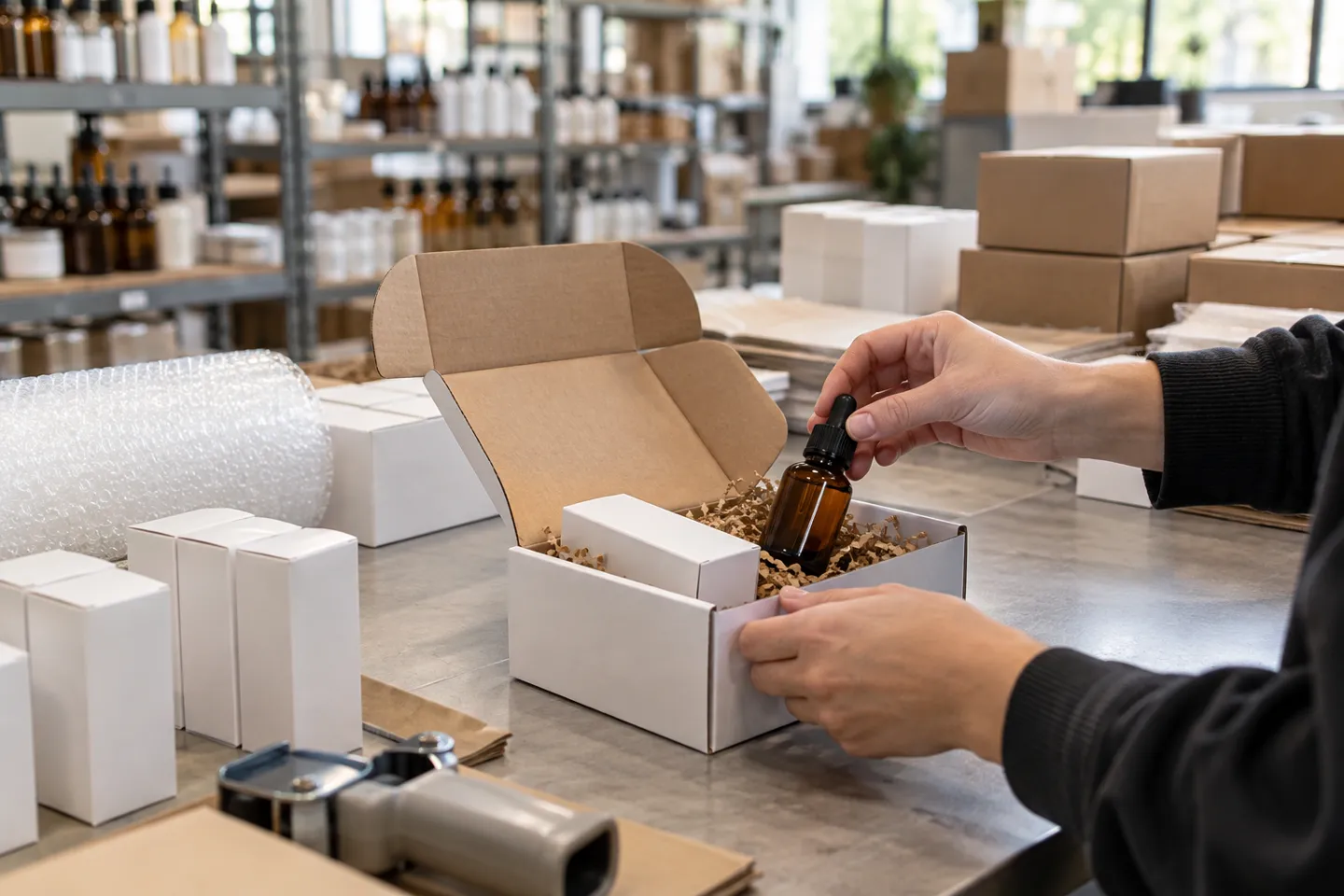
Who Can Deliver the Deep Layers
By this point the requirements of the deep layers are on the table, and they are worth collecting into one place, because the collection is the answer. A skincare brand at Depth 3 to 4 needs six things: formulation or at least formula-change control, batch-consistent quality with documentation, and dedicated stock that other buyers cannot dilute. It equally needs packaging that matches the storefront down to the insert card, a direct shipping lane with customs handled, and the ability to upgrade the product later without switching factories.
Check that list against the supply market and the shortage becomes obvious. SaaS platforms deliver one item (packaging skin) and none of the rest. Catalog platforms deliver breadth and per-order shipping but share their stock pools. Factories deliver formulation and batch quality but will not hold, pack, or ship your single orders. Local wholesalers are fast domestically but are not a formulation source. The only supply shape that covers all six requirements is the sourcing-plus-fulfillment agent operating dedicated warehousing, and only the subset of those agents whose quality control, stock separation, and packaging lines are demonstrably real. That is a statement about market structure, not about any particular company; the vetting checklist in the previous section is how you tell which subset you are talking to.
If you are building at Depths 1 and 2, none of this is urgent, and the shallow layers are served perfectly well by the platforms built for them. The structural judgment above matters at the moment you decide the skincare line is a brand, not a test.
The Business Read: Build on Verifiable Ground
Read the whole guide through one lens and a single commercial fact emerges. “Having skincare products to sell” is commoditizing: zero-minimum platforms have made a branded-looking store a weekend project, catalog breadth is identical for every reseller, and price is the only remaining lever in the shallow layers. “Being able to prove your products are right” is not commoditizing. Batch QC records, ingredient documentation, packaging that matches the promise, stock that holds, and delivery windows in writing cannot be copied from any catalog. That is where pricing power lives.
For the seller building a skincare brand on that logic, the operating conclusions are three, and each one traces back to ground already covered:
The operating shortlist
- Select suppliers by evidence, not price: batch QC records, ingredient documents, batch-consistency proof, packaging samples, written DDP windows. The checklist in the vetting section is the standard.
- Protect batch consistency structurally: dedicated stock over shared pools, batch codes on units, real-time inventory visibility. Repeat customers leave over a changed formula feel.
- Front-load compliance into product selection: check claims against the cosmetic/drug line, confirm the responsible-person and registration chain for your target markets before the first shipment, not after.
That third box is where the planning stage earns its keep. MoCRA has moved the US toward the EU’s older, stricter structure; the direction of travel is one-way. A skincare line architected around documented compliance and verifiable quality today is buying its future margins at launch prices.
This is also, plainly, the business we built SpeedBee Dropshipping around. Our model keeps your inventory in dedicated, non-shared storage rather than pooled bins, and syncs stock levels to your portal with 48-hour order processing. Packaging is built end to end, from outer boxes to custom packaging down to the insert cards and hangtag swaps, with four-stage quality checks before anything ships. When your formula or materials need upgrading, we handle it at the factory directly so your brand does not restart every time it improves.
If you are comparing supply partners for a skincare line, SpeedBee Dropshipping’s DDP door-to-door timelines (UK delivery in 4 to 7 days, customs and last mile included) are quoted in writing from the first inquiry.
Start Your Skincare Line on Verifiable Ground
Dedicated non-shared storage, four-stage quality checks, end-to-end custom packaging, and written DDP windows — the deep-layer requirements, delivered as one supply line.
Get a Skincare Supply QuoteReferences
- U.S. Food and Drug Administration. “Modernization of Cosmetics Regulation Act of 2022 (MoCRA).” 2022. https://www.fda.gov/cosmetics/cosmetics-laws-regulations/modernization-cosmetics-regulation-act-2022-mocra
- U.S. Food and Drug Administration. “Registration & Listing of Cosmetic Product Facilities and Products.” 2026. https://www.fda.gov/cosmetics/registration-listing-cosmetic-product-facilities-and-products
- U.S. Food and Drug Administration. “Is It a Cosmetic, a Drug, or Both? (Or Is It Soap?).” 2024. https://www.fda.gov/cosmetics/cosmetics-laws-regulations/it-cosmetic-drug-or-both-or-it-soap
- European Commission. “Cosmetic Product Notification Portal (CPNP).” 2026. https://single-market-economy.ec.europa.eu/sectors/cosmetics/cosmetic-product-notification-portal_en
- Federal Trade Commission. “Health Products Compliance Guidance.” 2017. https://www.ftc.gov/business-guidance/resources/health-products-compliance-guidance
- Reddit, r/dropshipping. “Your Skincare or Supplements Dropshipping Store Is Going to Fail.” 2026. https://www.reddit.com/r/dropshipping/comments/1s54ulk/your_skincare_or_supplements_dropshipping_store/
- Reddit, r/dropshipping. “Want to Start a Skincare Dropshipping Brand but Have a Few Concerns.” 2026. https://www.reddit.com/r/dropshipping/comments/1tuk2mu/want_to_start_a_skincare_dropshipping_brand_but/



 English
 Spanish
 French
 German
 Italian
 Polish